Screwworm in Texas, New Mexico and Arizona: what to check now
Published · 7 min read
How many screwworm cases are there?
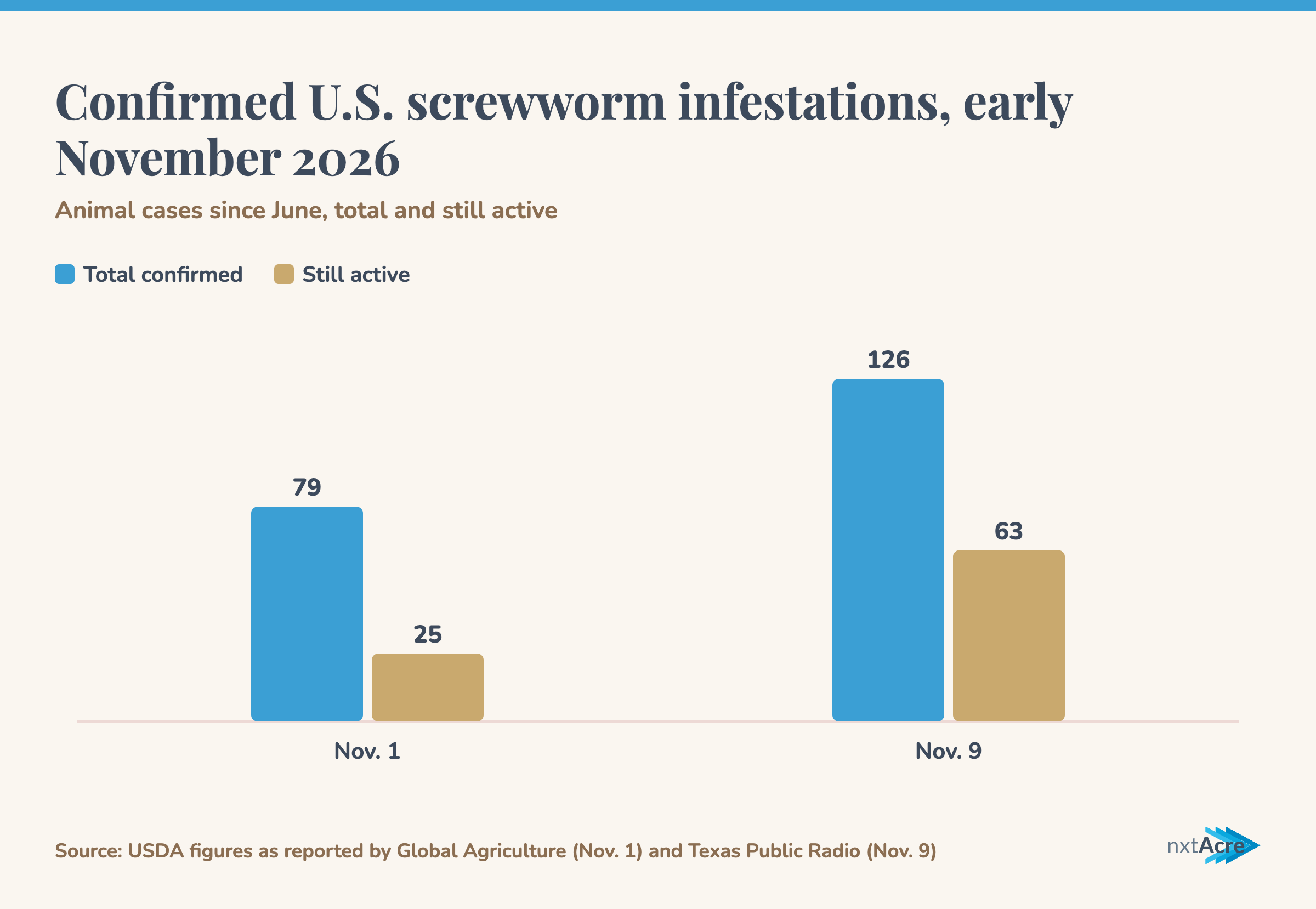
As of Monday, Nov. 9, USDA had confirmed 126 animal infestations of New World screwworm since June, and 63 of them were still active, Texas Public Radio reported. On Nov. 1 the count was 79, with 25 active. That's a jump of nearly 60% in eight days, and the active count more than doubled.
Cases are spread across Texas, New Mexico and Arizona, where USDA confirmed the first case Oct. 28, in a dog in Cochise County. TPR's Nov. 9 update lists new cases in a Bandera County horse, Reagan and Hudspeth county cattle, a Val Verde sheep, an El Paso dog and Luna County, N.M., cattle. Wildlife is in the count too. The first U.S. wildlife case, announced Oct. 21, was an elk a hunter harvested on a Pecos County game ranch. TPR counts a second elk, in Jeff Davis County.
Don't read much into that word. As TPR put it, an inactive designation “does not mean the surrounding area is free of the parasite.” USDA's screwworm page says this is not a food safety issue and that the current risk to animals and people in the U.S. is very low.
What screwworm does to an animal
Screwworm is a fly whose maggots feed on living flesh. According to a USDA APHIS brochure, the female lays her eggs on a wound or body opening of a live warm-blooded animal. That covers livestock, pets, wildlife and birds, and in rare cases people. Wounds as small as a tick bite can draw her. The eggs hatch within a few hours. The larvae burrow in and feed for about 7 days, then drop to the ground and pupate in the soil, and the adult fly comes out 7 to 54 days later depending on temperature and humidity. Left untreated, the brochure says, an infested animal may die within a week.
Warm weather speeds all of it up. Texas A&M AgriLife puts the high-risk window at 80°F and up with 30 to 70% relative humidity, when the whole life cycle runs in 2 to 3 weeks. Below 59°F it stretches to 2 to 3 months. A cold front slows things down. It doesn't end them.
The money at stake is large. In May, Dallas Fed economists estimated that a repeat of 1972, the year with the most screwworm cases, could cost the Southwest $2.5 billion.
What should I check on my cattle every day?
AgriLife's beef cattle field guide says to evaluate animals daily or several times a week during high-risk periods, especially calves soon after birth and cows soon after calving, because infestations develop fast. Its list of the spots most often infested:
- The umbilical cord and navel, or the sheath
- Rectum and vulva
- Eyes, nose, mouth and ears
- Legs, the space between the claws, and anywhere animals get cut or rub a sore
- The scrotum after castration, the horn base after dehorning, and brand sites
- Ears after a tag, tattoo, notch, implant or tissue sample, and any other incision or wound
Signs of trouble, per the guide: swelling or redness, a bloody, pus or straw-colored discharge, maggots you can see, licking at one spot, kicking at the belly and a foul smell. USDA's reporting page adds wounds that drain or keep growing. It also says there's no need to watch for the flies, because the sterile flies being released for eradication can look like wild ones. Watch the wound instead.
Should I put off castrating, dehorning and branding?
If you can, yes. AgriLife files castration, ear tagging, branding and dehorning under the cooler, low-fly season, and for the warm months it says to reconsider any elective wound-causing task.
If calves have to be worked, talk to your vet first. The field guide recommends treating newborn calves to help prevent navel infestation, treating cows that needed help calving, prolapsed or retained a placenta, and treating castration and dehorning wounds. It also says to disinfect taggers, knives and implant guns between animals.
Read the withdrawal times before you pick a product. The guide lists 35 days for Dectomax CA-1 and Ivomec injectable, 30 days for the F10 wound spray and ointment. Products sold under an emergency use authorization can only be used exactly as the label says. Which product, what dose and when is a call for you and your herd vet.
Horses and boarding barns
Horses get it too. The first U.S. horse case was a working ranch horse in Presidio County, found Sept. 9 with the parasite in a hind leg, and the Bandera County case in TPR's Nov. 9 update was also a horse.
The U.S. Equestrian Federation, in guidance updated Oct. 13, tells owners to inspect horses daily for wounds or larvae, small cuts included, and to clean and protect any wound right away with products your vet recommends. It names healing surgical sites, umbilical areas, lips, nostrils, eyes and genitals as vulnerable, and suggests vet-directed fly control plus fly masks and sheets.
In a boarding barn, the part that slips is who does the daily look. Put a name on it for every horse, and tell boarders who that is.
Hauling takes planning. TAHC's movement rule covers all warm-blooded animals in an infested zone, so horses are in it. For shows, USEF says to check the rules in both your origin and destination states. Horses from an infested zone with active cases have to be inspected on arrival before they go into the stabling area.
How do I report a suspected screwworm case?
In Texas, call the Texas Animal Health Commission region office or the veterinarian on call at 1-800-550-8242. Screwworm is reportable to TAHC within 24 hours of suspicion. Suspected cases in wildlife go to Texas Parks and Wildlife at 512-389-4505.
Outside Texas, USDA says to have your veterinarian look at the animal, and its page links to state animal health officials by state. For maggots in a live or freshly dead wild animal outside Texas, call USDA Wildlife Services at 866-487-3297.
AgriLife puts it in capital letters: don't wait. Isolate the animal and make the call. The field guide adds that you shouldn't haul the animal or its herd mates anywhere.
Can I move cattle or horses out of an infested zone?
Not without prior authorization. TAHC says warm-blooded animals in an infested zone may not leave it without TAHC's OK. A TAHC or certified screwworm inspector has to examine them and fill out a movement and treatment certificate, listing the product used and each animal's official ID, that travels with the animals. TAHC's number for scheduling an inspector in a zone is 512-714-1936.
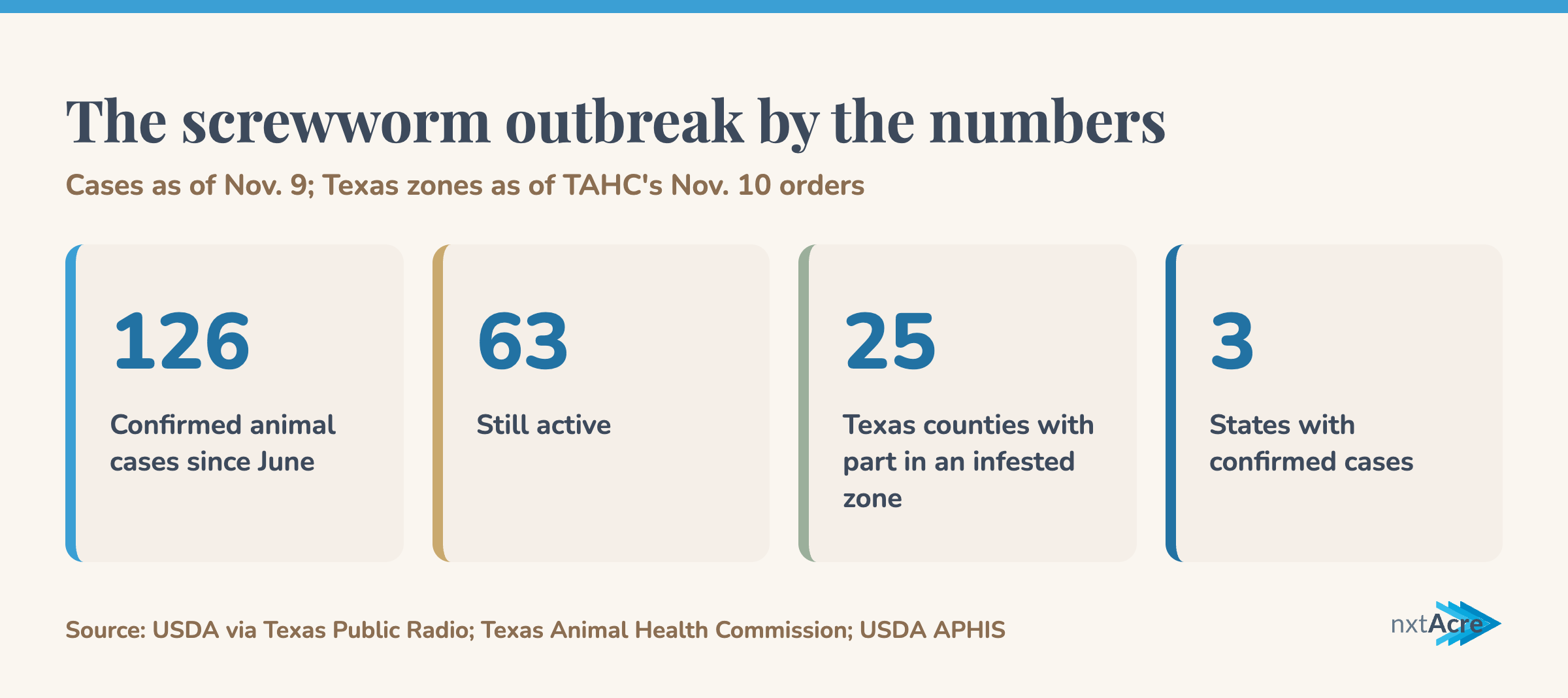
TAHC's notice lists parts of 25 Texas counties in an infested zone: Bandera, Brewster, Crockett, Culberson, Edwards, El Paso, Fisher, Hudspeth, Irion, Jeff Davis, Jim Hogg, Medina, Mitchell, Nolan, Pecos, Presidio, Reagan, Reeves, Schleicher, Scurry, Starr, Sutton, Terrell, Val Verde and Zapata. The zones move. TAHC issued or modified orders on eight separate days between Nov. 1 and Nov. 10, so check the map before you load the trailer. For New Mexico zones, USDA points to the New Mexico Livestock Board.
Keep the inspection and treatment records now
AgriLife's field guide is blunt about it: individually identify treated animals, keep treatment records, and make sure treated animals have cleared slaughter withdrawal and have TAHC transportation approval before they leave the place.
A useful record is short. For each check or treatment, write down the animal or group, the date, who looked, what they found, the product and lot number, the dose, the withdrawal date and any certificate number. In nxtAcre, treatments go in as health events on the animal or group in Livestock (product, dose, lot number, who gave it and the withdrawal date), and the staff app lets the crew add a health record from a phone.
What we'd do before the next set of calves gets worked: put a daily check on the calendar for every newborn and every wound, call your vet about a treatment plan, and save the TAHC and state numbers in every phone on the place.
Questions and answers
Can people get screwworm?
Yes, in rare cases, according to USDA. As of Oct. 29, CDC said there had been no reports of human cases acquired in the United States and that the risk to people remains very low. If you see or feel maggots in a wound, CDC says to contact your healthcare provider right away and not to try to remove them yourself.
Is beef from an infested area safe to eat?
USDA says screwworm is not a food safety issue and the U.S. food supply remains safe. The concern is the animals and the cost of treating them. Treated cattle do have to clear the product's slaughter withdrawal before they go to market.
If my county isn't in an infested zone, do I need to do anything?
TAHC's movement restrictions apply inside the zones, and TAHC has been redrawing them every few days. USDA asks anyone who sees a suspicious wound to report it, zone or not.