How to record USDA payments in your books and on Schedule F
Published · 8 min read
Is a 2025-crop USDA payment received in 2026 taxable in 2026?
Yes, if you're on the cash method. Cash-method farmers include in income everything they actually or constructively received during the tax year (IRS Pub. 225). The crop year on the program doesn't decide it. The date the money was yours does.
That matters more than usual for 2026, because two big payments for the 2025 crop both came in calendar 2026. Farmer Bridge Assistance enrollment ran Feb. 23 to April 17, 2026, with a later window for blue and red corn from Aug. 27 to Sept. 28, according to FSA's FBA handbook. No FBA money could have arrived before 2026. The final 2025 ARC and PLC payments were due to reach producers by the end of October, according to farmdoc daily.
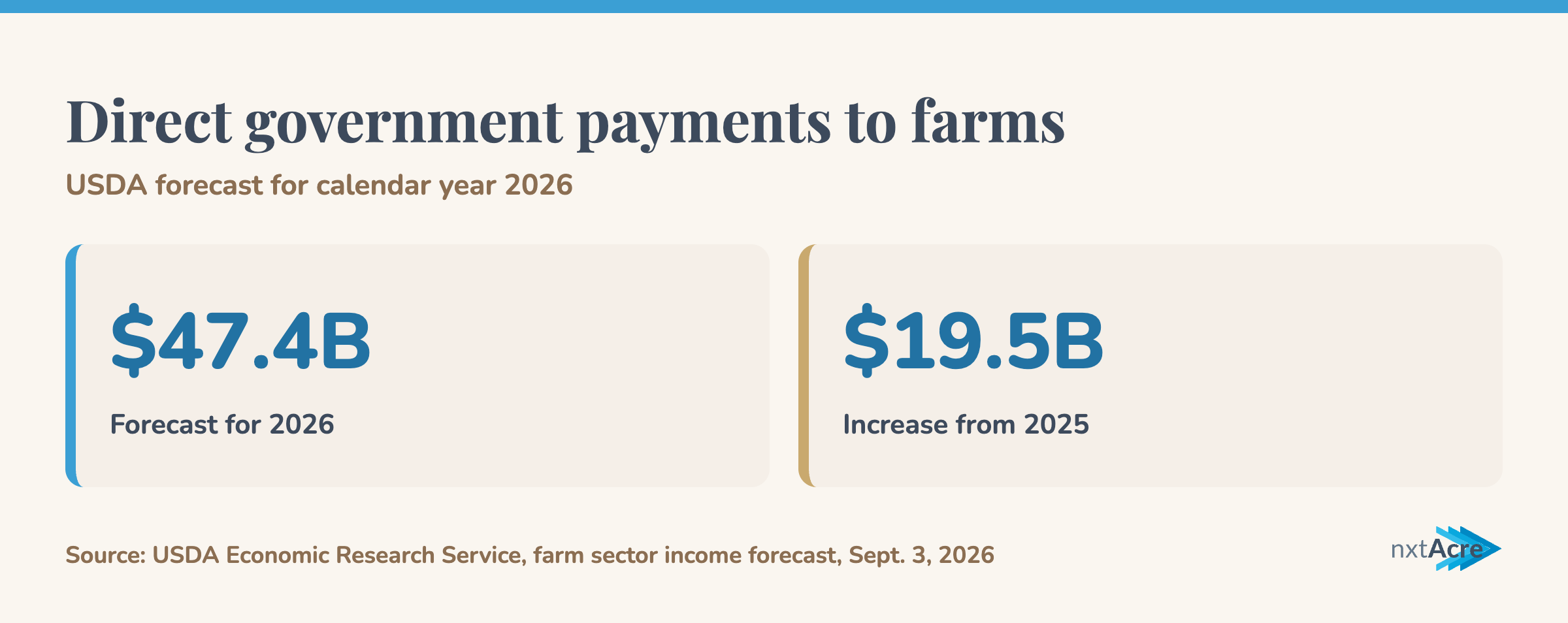
The money shows up in the national numbers too. ERS's Sept. 3 forecast puts direct government payments at $47.4 billion for 2026, up $19.5 billion from 2025. ERS credits most of the increase to commodity payments tied to prices and revenues, plus more supplemental and ad hoc disaster assistance.
You can't push a check into 2027 by leaving it in the envelope, either. Pub. 225 says you can't hold checks to avoid paying tax on the income. If the money was received or made available to you without restriction, it counts that year.
What FBA and 2025 ARC/PLC paid
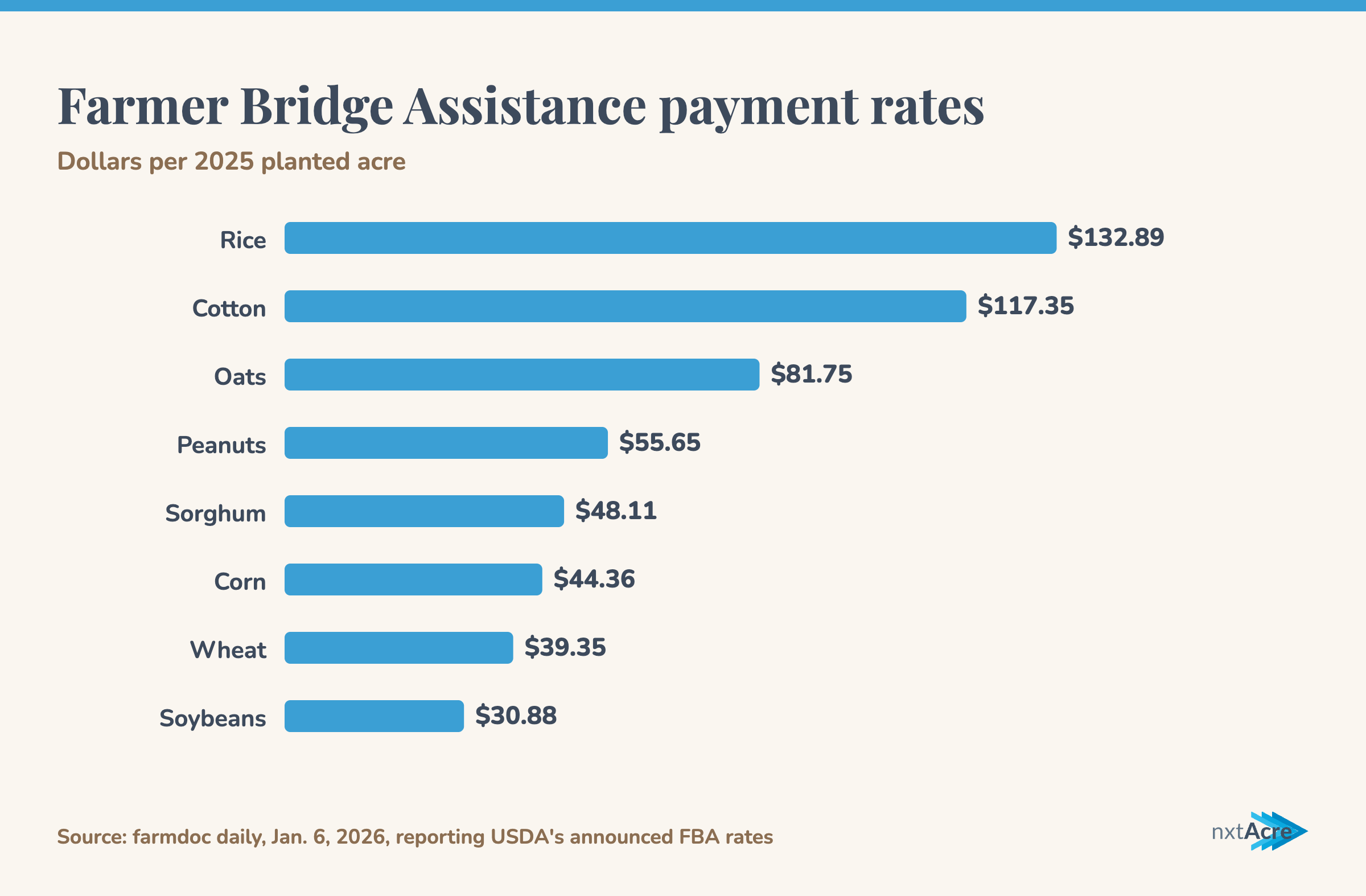
FBA was figured by multiplying a flat payment rate for each commodity by the acreage you timely reported on your 2025 FSA-578, according to the program's final rule. Double-crop and subsequent-crop acres counted. Prevented-planting acres didn't, the handbook says. Because it's rate times reported acres, you can check your FBA total against your 2025 acreage report.
ARC and PLC are harder to predict, since they depend on your county, your base acres and your PLC yields. For the 2025 crop, farmdoc daily estimated payments averaging $51 per base acre for corn, $29 for soybeans and $47 for wheat. The authors note that an individual farm's rate can differ from their county estimates.
Add up what actually came in before you meet your preparer. ERS's September forecast has 2026 net farm income down 5.5% from 2025 after inflation, but two program checks in one year can still make your own 2026 return bigger than the grain checks alone would suggest.
Where do USDA payments go on Schedule F?
Most go on line 4a, Agricultural program payments, with the taxable amount on 4b. The Schedule F instructions list price loss coverage, agriculture risk coverage, Market Facilitation Program payments, market gain on CCC loans, diversion payments and cost-share payments there.
The same instructions include a table for forms you receive. Amounts on a 1099-G or CCC-1099-G go on line 6a if they're disaster payments and line 4a if they're other agricultural program payments. Federal crop disaster payments are treated as crop insurance proceeds, and certain ones can be deferred to the next year under the crop insurance election.
Where does FBA fall? Neither the Schedule F instructions nor FSA's FBA rule or handbook names a Schedule F line for it. The FBA handbook lists Section 5(b) of the Commodity Credit Corporation Charter Act as the program's authority, and it points county offices to FSA's separate handbook for reporting payment data to the IRS. Look at how the payment is described on your CCC-1099-G and let your preparer pick the line from there.
Line 5a is for CCC loans, but only if you elected to report the loan proceeds as income when you got them. The instructions say that in most cases you don't report CCC loan proceeds as income.
Conservation cost-share is the one place part of a payment may stay off the return. Pub. 225 lets you exclude some cost-share money for capital improvements if it meets three tests, and you reduce the improvement's basis to match. Cost-share for an expense you can deduct in the year you pay it can't be excluded.
How to book program payments so they tie to the CCC-1099-G
Give them their own income account. Don't let an FSA deposit drop into grain sales or "other income." Schedule F puts program payments on a different line than crop sales, and you'll want the totals sitting there on their own when the form shows up.
A sub-account or tag per program helps: FBA, ARC/PLC, conservation cost-share, disaster. The Schedule F instructions say the CCC-1099-G shows the amounts and types of payments made to you, so add up each bucket for the calendar year and compare it to the matching line on the form.
nxtAcre's Tax Center builds a Schedule F worksheet from your books, including line 4a, and its year-end checklist lists the 1099-G or CCC-1099-G as a form to expect when you've booked program payments, so you'll notice if one hasn't arrived.
What if USDA kept part of my payment?
Report the whole payment anyway. Pub. 225 says to report the full amount of a program payment even if you return a check, refund part of it, or the government collects from you by reducing some other payment or a marketing assistance loan. You deduct what was refunded or withheld on Schedule F, Part II, for the year it happened.
Offsets are a real possibility with FBA. The FBA handbook says payments are subject to administrative offsets, and the program's final rule applies the federal debt-offset regulations in 7 CFR part 3. If your deposit came in short, find out from your county office what was collected and record the full payment plus what it paid.
Sequestration is the other reason a deposit won't match the rate sheet, and it doesn't hit both programs the same way. farmdoc daily says a 5.7% sequestration factor applies to 2025 ARC and PLC payments. The FBA handbook says sequestration doesn't apply to bridge payments. Tie out to the 1099 instead.
The opposite mistake is counting a payment twice. If the deposit hits your operating account and you move it to savings or pay down the line of credit, that second entry is a transfer, not income. With bank feeds on two accounts, it's easy to categorize both sides as income if nobody marks the transfer.
Payment limits, spouses and entities: questions for your preparer
FBA payments to a person or legal entity, other than a joint venture or general partnership, were capped at $155,000. A person or entity whose average adjusted gross income for 2021 through 2023 topped $900,000 couldn't get a payment at all (final rule). The handbook requires every applicant to have an FSA customer record with a valid taxpayer ID.
FSA pays against the taxpayer ID on that customer record, so how your operation is set up with FSA matters at tax time. Worth asking about:
- If you and your spouse are each set up with FSA, does each 1099 match how you'll file? The Schedule F instructions let spouses who jointly run an unincorporated farm file as a partnership or, if they qualify, each file a Schedule F as a qualified joint venture.
- If an LLC or partnership got the payment, which return does it belong on?
- Pub. 225 sends crop-share landlords who don't materially participate to Form 4835, not Schedule F.
- If the farm changed structure in 2025 or 2026, do FSA's records and your books agree on who got paid?
Specialty crop growers had their own one-time bridge payments under Assistance for Specialty Crop Farmers, with its own rule published June 1, 2026. The bookkeeping works the same way.
What we'd do before January
- Pull every FSA deposit for calendar 2026 and sort them by program.
- Find any payment that was offset or reduced, and record the full amount plus what it paid.
- Ask your FSA county office for a list of every 2026 payment and offset in your name, and compare it to your deposits.
- When the CCC-1099-G arrives, tie it to your books before it goes to your preparer.
This article is general information, not tax advice. Confirm how it applies to your farm with your tax preparer.
Questions and answers
Is the Farmer Bridge Assistance payment taxable?
Pub. 225 says you must include most government payments in income. The exclusion it describes covers only certain cost-sharing conservation, reclamation and restoration programs tied to an improvement, and FBA is a per-acre bridge payment, not a conservation program.
Which year do I report FBA if it was for my 2025 crop?
On the cash method, report it in the year you received it. FBA enrollment didn't open until Feb. 23, 2026, so it's 2026 income.
Do ARC and PLC payments go on line 4a or 6a?
Line 4a. The Schedule F instructions list both as agricultural program payments. Line 6a is for crop insurance proceeds and federal crop disaster payments.
What if my CCC-1099-G doesn't match my deposits?
Check for offsets first, since the full payment is income even when part went to a debt. Then look for transfers you may have booked twice and remember the 5.7% sequestration on ARC and PLC. If it still doesn't tie, your FSA county office can review the payments with you, and your preparer decides how to report them.