Deworming every horse every eight weeks is how we bred resistant worms. Here's the newer approach
Published · 4 min read
If you learned to deworm horses by running a tube of paste through every horse in the barn every couple of months, that habit is now part of the problem. Decades of treating every horse on a calendar, whether it needed it or not, bred worms that shrug off the dewormers we've counted on. Penn State Extension, summarizing the American Association of Equine Practitioners, lays out where it stands and what to do instead. (Penn State Extension)
Which dewormers are losing ground
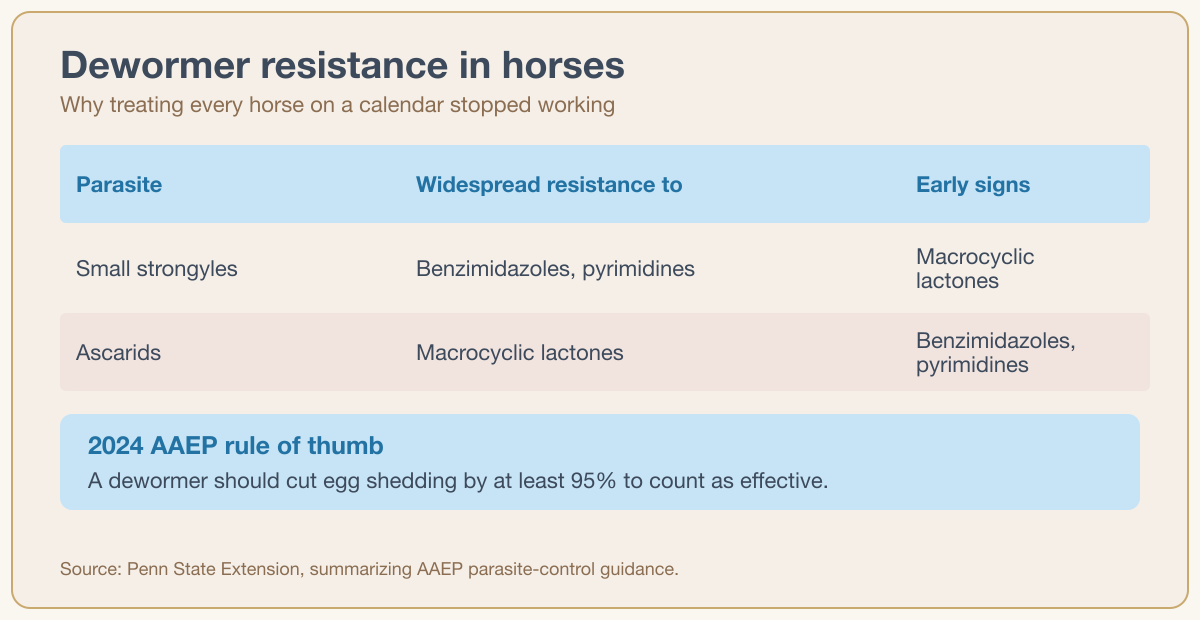
Per the Penn State summary, small strongyles, the most common worm in adult horses, already have widespread resistance to the benzimidazoles (fenbendazole, oxibendazole) and the pyrimidines (pyrantel), with early signs of resistance to the macrocyclic lactones (ivermectin, moxidectin). Ascarids, which hit foals and young horses hardest, have widespread resistance to those same macrocyclic lactones. In other words, the product that works depends on the parasite and on your own farm, and you can't tell by guessing.
Stop guessing: the fecal egg count
A fecal egg count, or FEC, is a lab look at a manure sample that counts parasite eggs and sorts each horse into a low, moderate or high shedder based on eggs per gram. It turns out worm burden isn't spread evenly: a small share of horses carry most of the worms. Find your high shedders and you can aim treatment where it matters instead of blanketing the whole barn.
One honest limit, straight from the source: an FEC doesn't catch encysted larvae, so a result of zero does not mean a horse has no parasites. FECs are something you keep doing through a horse's life, not a one-time test.
Find out what still works on your farm
This is the step most people skip. A fecal egg count reduction test, or FECRT, tells you whether a dewormer still works in your pastures. Penn State describes the method: test at least five horses shedding over 300 eggs per gram that graze together, take a count before treatment (at least eight weeks after the last deworming) and again 14 days after, and see how far the egg count dropped.
On the threshold for calling resistance, the guidance tightened. The older class-by-class cutoffs were below 85% for pyrantel, below 90% for fenbendazole or oxibendazole, and below 95% for ivermectin or moxidectin. The 2024 AAEP update simplified it: any dewormer should cut egg shedding by at least 95% to count as effective. Ask your vet which threshold they're applying.
How often adult horses really need it
Less often than the old calendar said, for most. The AAEP recommends every adult horse get at least one to two dewormings a year depending on climate, per Penn State. Horses that test as high shedders, over 500 eggs per gram, need more, in the range of three to four treatments a year. Foals and young horses are their own case and need more frequent attention, so talk to your vet about them specifically.
None of this means never deworm. It means deworm with information. A simple way to keep that information straight is to log each horse's fecal egg counts and treatments in nxtAcre, so you can see at a glance who your high shedders are and what you gave them last. Your veterinarian is the one to build the actual plan, since the right products and timing depend on your parasites, your climate and your pastures.
Questions and answers
How often should I deworm an adult horse?
The AAEP recommends at least one to two times a year depending on climate, per Penn State Extension. Horses that test as high shedders, over 500 eggs per gram, may need three to four treatments. Foals and young horses need more frequent attention.
What is a fecal egg count?
It's a lab count of parasite eggs in a manure sample that sorts a horse into a low, moderate or high shedder. It helps target treatment, but it misses encysted larvae, so a zero count doesn't mean a horse is parasite-free.
How do I know if a dewormer still works on my horses?
Use a fecal egg count reduction test: count eggs before treatment and 14 days after on at least five horses that graze together. The 2024 AAEP update says a dewormer should reduce egg shedding by at least 95% to be considered effective.
Why is dewormer resistance a problem now?
Small strongyles are widely resistant to benzimidazoles and pyrimidines, and ascarids to macrocyclic lactones, according to Penn State Extension. Treating every horse on a calendar accelerated it, which is why testing-based deworming is now recommended.