How to budget H-2A wages for 2027 under the two-tier AEWR
Published · 8 min read
What is the H-2A wage rate right now?
It depends on your state and on which of two skill levels the job falls in. DOL's Aug. 3 Federal Register notice set the current rates, effective that day (Aug. 17 for employers covered by the Kansas v. DOL court order). They're built from the Bureau of Labor Statistics wage survey (OEWS), May 2025 estimates, not USDA's Farm Labor Survey.
The tiers came in with DOL's October 2025 interim final rule; the Aug. 3 rates are the second set published under it. Level I covers jobs that don't require formal education or specialized training. Level II covers jobs that call for experienced or fully proficient workers. DOL's rate file says Level I is the average of the bottom third of the state's wage distribution for the farm occupations DOL groups together, and Level II is the average of the whole distribution.
Then there's the housing adjustment, a cut to the hourly rate based on HUD's fair market rent for a four-bedroom unit in your state. It applies only to H-2A workers who get housing at no cost. U.S. workers in corresponding employment get the unadjusted rate.
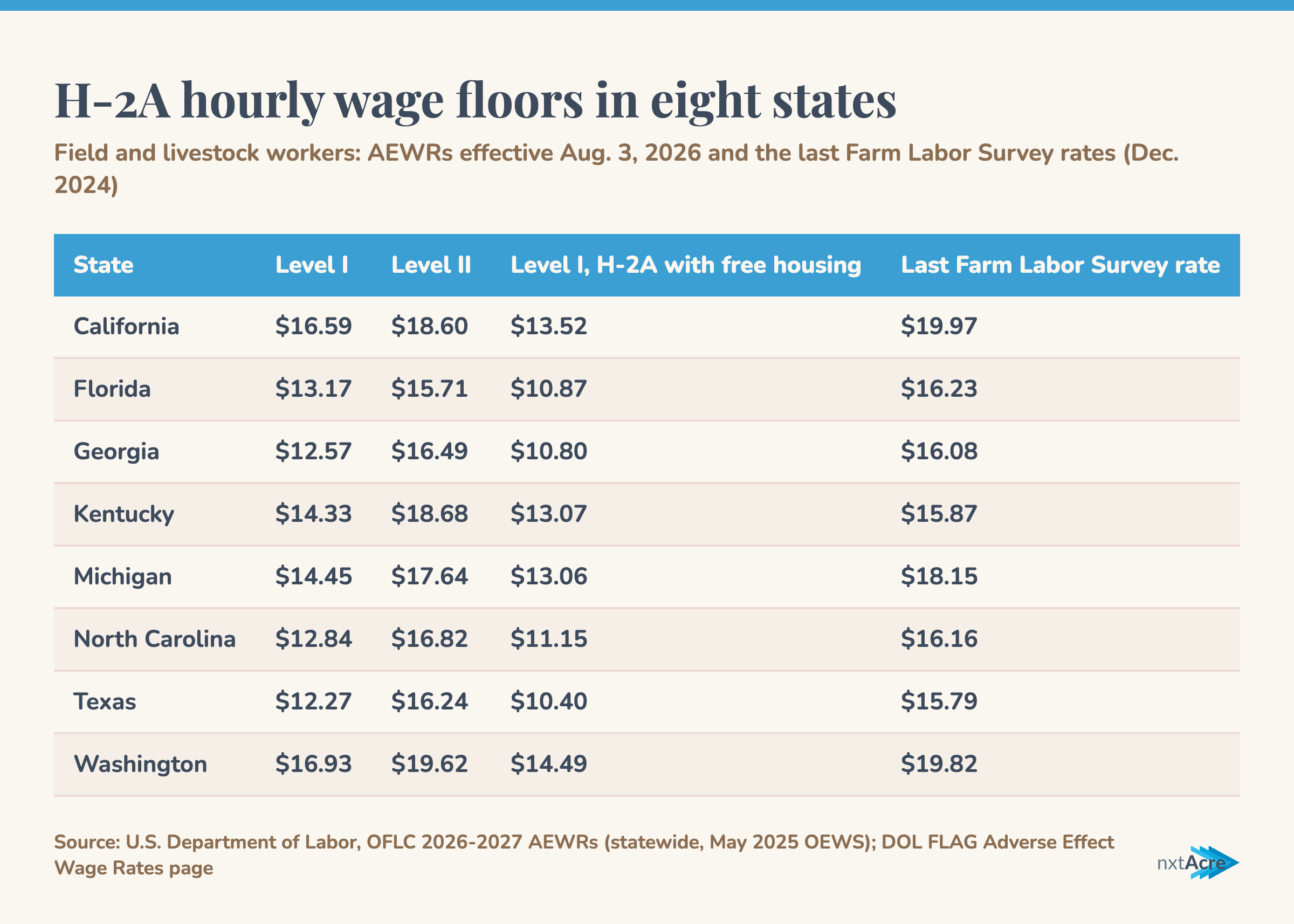
Take North Carolina. Level I is $12.84 for U.S. workers and $11.15 for H-2A workers after a $1.69 housing adjustment. Level II is $16.82, or $15.13 adjusted. The last Farm Labor Survey rate, effective Dec. 16, 2024, was $16.16 for everyone.
The AEWR is a floor, not the whole answer. The Aug. 3 notice says you owe the highest of the AEWR, any prevailing wage for the crop and task, a collective bargaining rate if you have one, and the federal or state minimum wage.
What did the court decide about the H-2A rates?
It found the method unlawful but left the rates in place for now. In United Farm Workers v. DOL, the U.S. District Court for the Eastern District of California ruled on Aug. 26 that the parts of the 2025 rule the challengers targeted were arbitrary and capricious: the skill tiers, the housing adjustment, the reliance on OEWS data and the "greater than 50%" rule that assigns a mixed job to the occupation covering most of the worker's time. It also found DOL hadn't shown good cause to skip normal notice-and-comment rulemaking for most of those changes.
The court didn't vacate the rule. It sent it back to DOL to write a new methodology. Fisher Phillips, a law firm that represents employers, noted the court said tiers aren't unreasonable in themselves; the problem was the percentiles DOL used to set them.
DOL then told employers on Sept. 2 that current rates stay in effect until new ones are published. It also warned that employers may have to make wage adjustment payments for a "backpay period" that started Sept. 2 and runs until the new rates come out, but only to workers paid below the new rates. DOL says no payment obligation exists at this time.
On Oct. 2 the court set a deadline. DOL has to issue a new interim final rule by Dec. 30, 2026, and the current rule will be vacated effective that same day, Western Growers reported. The court turned down DOL's request for up to six more months, MLex reported, and ordered joint status reports every three weeks, the first due Oct. 22. The Congressional Research Service confirms the Dec. 30 date.
Nobody knows yet what the replacement looks like; Western Growers noted the order doesn't specify a methodology or new rates. Between Aug. 4 and Oct. 22, DOL had published no new AEWR notice or rule in the Federal Register.
Can my H-2A wage rate change in the middle of the season?
Yes, though only upward. The Aug. 3 notice spells it out. If a new AEWR takes effect during your contract and it's higher, you pay it from its effective date. If it's lower, you keep paying at least the rate in your job order.
So a 2027 contract could see two changes: whatever DOL issues by Dec. 30, and the regular annual update DOL publishes "on or about July 1 each year," per CRS. That's why the budget needs a range, not one number.
Price your crew from DOL's tables, at the rate you'd pay today for the skill level you're filing, and again at your state's last Farm Labor Survey rate. In every state in the table above, that old rate is higher than Level I. A Level II employer in North Carolina is already paying more than the old rate; a Level I employer there pays $12.84 to U.S. workers, $3.32 under the $16.16 old rate, before any housing adjustment.
The backpay question works the same way. Any money owed would cover hours worked since Sept. 2, and only where the replacement rate beats what you paid. We'd hold some cash back until the court rules on it.
How do I decide if a job is Level I or Level II?
Look at what your job order actually requires. DOL's definitions turn on requirements: Level I is for positions that don't require formal education or specialized training, and Level II is for positions that require experienced or fully proficient workers who've shown the skills through education, training or experience. If your job order asks for months of experience or a license, read it against the Level II definition.
Most jobs are expected to land in Level I. The court's ruling notes that the 2025 rule estimated 92% of H-2A positions would be classified Level I and 8% Level II.
Rates also moved from last year. AFBF calculated a simple average of the H-2A rates: $12.31 an hour for Level I across states and territories in the August update, up 3.5% from $11.89, and $16.07 for Level II, up 2.1% from $15.76.
The H-2A costs that aren't the hourly rate
Beyond the hourly rate, the program rules put several more costs on the employer:
- The three-fourths guarantee. You must offer each worker at least three-fourths of the work hours in the contract period, so a wet spring doesn't cut the bill as much as it cuts the work.
- Housing at no cost to H-2A workers, inspected and certified before the first date of need.
- Three meals a day, or free and convenient cooking facilities.
- Inbound travel and daily subsistence, paid once a worker finishes half the contract, plus the trip home at the end.
- Free daily transportation between housing and the worksite, in vehicles that meet safety, licensing and insurance standards.
On taxes, the IRS says H-2A workers are exempt from Social Security and Medicare tax on that pay, and you don't have to withhold federal income tax unless you and the worker agree to it. You still report pay of $600 or more on a W-2, and on Form 943 you leave the Social Security and Medicare wage lines blank for those workers. U.S. workers on the same crew are taxed normally.
Records to keep in case back wages come due
If the court orders wage adjustments, you'll need to show who worked which hours at which rate. The recordkeeping rule already requires hours offered, hours actually worked, start and stop times, pay rates, earnings and every deduction, kept for at least three years after certification. On or before each payday, workers get a statement with hours offered, hours worked, rates and deductions.
The Sept. 2 notice also reminds employers to record each worker's name and permanent home address, plus email and phone where available, and keep it current. Paying back wages to someone who's already gone home is a lot harder without it.
In nxtAcre's payroll you can mark an employee as H-2A, and their pay stubs then leave out Social Security and Medicare and record hours and pay. The Tax Center drafts Form 943 from those same stubs.
What we'd do before filing for 2027
- Price your 2027 crew at today's rate for your skill level and at your state's last Farm Labor Survey rate.
- Reread each job order's requirements and make sure the skill level matches.
- Set aside a backpay reserve for hours worked since Sept. 2.
- Watch for DOL's replacement rule, due by Dec. 30, and check with your agent or attorney before you file.
Congress could change all of this, but we wouldn't plan 2027 around it. The Securing Agriculture's Workforce Act (H.R. 9535), which would reform wage calculations, had been introduced and was waiting on the House Judiciary Committee as of Farm Credit East's Aug. 25 write-up.
Questions and answers
What is the difference between H-2A Level I and Level II wages?
Level I applies to jobs that need no formal education or specialized training. Level II applies to jobs requiring experienced or fully proficient workers. Level II is higher; in North Carolina it is $16.82 an hour for U.S. workers versus $12.84 for Level I.
Do I owe H-2A back pay because of the court ruling?
Not yet. DOL says employers may owe wage adjustments for work since Sept. 2, 2026, but only to workers paid below the replacement rates. The court will take up backpay after DOL issues new rates.
Do U.S. workers get the housing adjustment?
No. The housing adjustment applies only to H-2A workers who get housing at no cost. U.S. workers in corresponding employment must be paid the full, unadjusted AEWR.
Are H-2A wages subject to Social Security and Medicare tax?
No. The IRS says H-2A workers are exempt from Social Security and Medicare tax on that pay, and income tax withholding is only by agreement. You still issue a W-2 for pay of $600 or more.