The farm bill is stuck again. The commodity part already passed without it
Published · Updated · 4 min read
Here's a question worth kicking around at the coffee shop. The 2018 farm bill expired in 2023 and the country has been getting by on short-term extensions ever since, and as of mid-November 2026 the House and Senate still can't agree on a new one. And yet the commodity-title money, the part most row-crop farmers actually care about, already got changed last year through a different law. So what is the farm bill even for at this point?
Where it actually stands
The House passed its version, the Farm, Food and National Security Act of 2026 (H.R. 7567), on April 30, 2026 by a vote of 224 to 200, with 14 Democrats and all but three Republicans voting yes, according to Farm Aid's tracker. On the Senate side, the Agriculture Committee stalled out on Aug. 6, then passed a bill along party lines, 12 to 11, on Sept. 16. It still needs 60 votes on the Senate floor, and nobody will tell you when that vote happens.
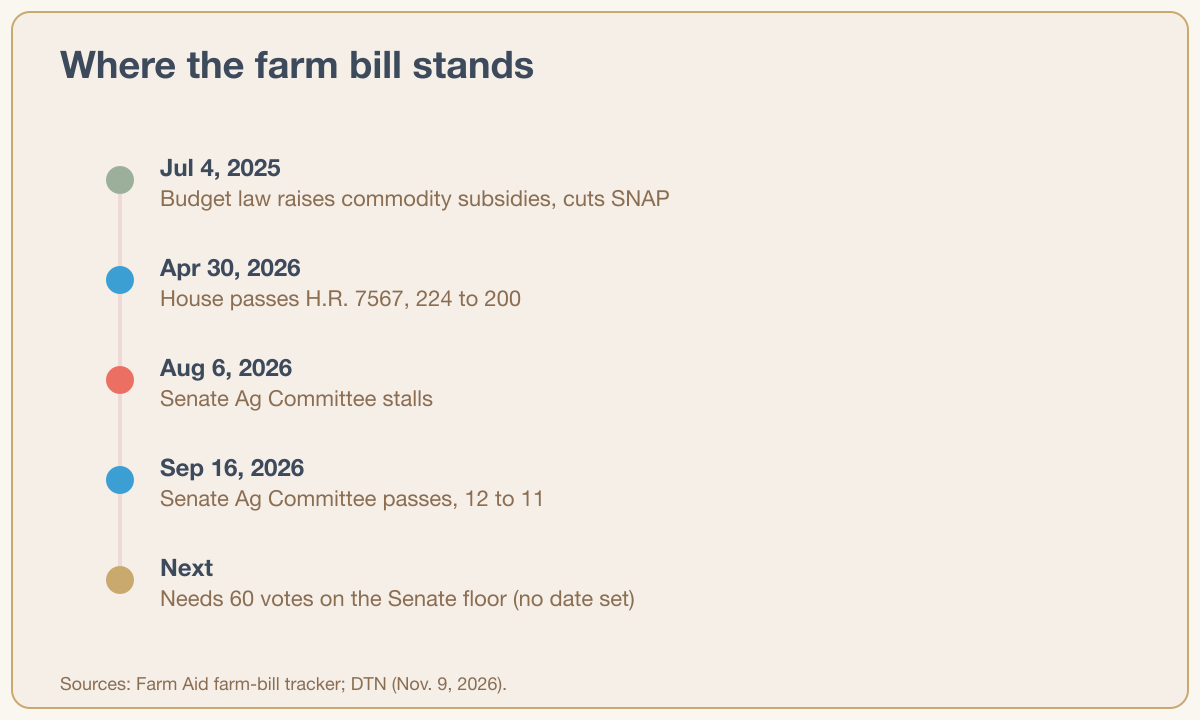
The House acted in April. The Senate bill has cleared committee and is waiting on 60 floor votes.
Why it's stuck
The sticking point isn't tractors or reference prices. It's food stamps. DTN reported on Nov. 9 that the main obstacle is nutrition and SNAP, with Democrats holding a two-year cost-sharing position and Sen. Chuck Grassley saying a compromise will probably be needed "to get 60 votes." Side fights over conservation rules, country-of-origin labeling, a Proposition 12 repeal, and E15 are tangled up in it too, per DTN. On top of that, a government funding deadline was bearing down on Dec. 11, so the farm bill is fighting for floor time.
The part that already happened
This is the piece that changes the whole argument. The One Big Beautiful Bill Act, signed July 4, 2025, already raised commodity subsidies and cut SNAP funding, per Farm Aid. DTN describes that same law as having driven a wedge between the nutrition and commodity sides of farm policy that were always bundled together to pass as one bill. In other words, Congress pulled the farm-program money out and passed it on its own, which is a big reason the leftover bill is so hard to move.
So what's a farm bill even for now?
That's the part people disagree on, and it's a fair fight on both sides.
One view says splitting nutrition off from farm programs is overdue, that food stamps were only ever stapled to the farm bill to buy city votes for farm spending, and that farmers are tired of their safety net being held hostage to a food-stamp fight every few years. The other view says that bundle is the only reason the farm bill ever passes at all, and that pulling it apart leaves conservation, crop insurance rules, trade promotion, and the programs smaller and specialty operations lean on with no engine to move them.
We don't know how this lands. The dates above are what reputable outlets were reporting in early November, and farm-bill timelines have a long history of slipping, so take any prediction with salt. What we'd say is that the parts of this bill still in limbo, the conservation and crop-insurance and labeling pieces, matter plenty even if the headline money already moved. When your program payments do come through, book them so you know your real margin instead of guessing. That's the part you control.
What do you think? Should food stamps even be in the farm bill, or is it time to split them off for good? We'd like to hear it from people who actually farm.
Questions and answers
Is there a current farm bill in 2026?
No. The 2018 farm bill expired in 2023 and parts of it have been kept going by short-term extensions, per Farm Aid. The House passed its 2026 version in April, and the Senate Agriculture Committee advanced a bill in September, but as of mid-November neither had become law.
Why is the farm bill stuck?
The main sticking point is SNAP, the food-stamp program, specifically a cost-sharing dispute. Fights over Proposition 12, E15, conservation and country-of-origin labeling are also unresolved, and the bill is competing with a government funding deadline for floor time.
Did farm commodity programs change without a farm bill?
Yes. The budget reconciliation law signed July 4, 2025 raised commodity subsidies and cut SNAP funding, moving much of the commodity-title money outside the stalled farm bill.