Farm bill in the lame duck: what's settled and what isn't
Published · 7 min read
Does the expired farm bill stop my ARC or PLC payments?
No. The commodity programs most row-crop farms care about were rewritten in the reconciliation law passed July 4, 2025, which FSA calls the Working Families Tax Cuts Act, also known as the One Big Beautiful Bill Act. According to the Congressional Research Service, that law "amended and reauthorized most of the farm commodity programs through crop year 2031." That's why FSA is taking 2026 sign-ups, with contracts that can run through 2031, even with the 2018 bill lapsed.
It also raised the numbers. Statutory PLC reference prices went from $3.70 to $4.10 for corn and from $8.40 to $10.00 for soybeans, the ARC guarantee went from 86% to 90% of benchmark revenue, and the payment limit rose from $125,000 to $155,000 for individuals (AgriNews summary of the law). After FSA's escalator formula, the 2026 effective reference prices are $4.42 for corn, $10.71 for soybeans and $6.35 for wheat.
The law added up to 30 million new base acres too. So many acres qualified that FSA cut every new allocation by 3.69% to stay under the cap, per its ARC/PLC program page. If you own land, you can see your base allocation notice there with a Login.gov account, or get it from the county office.
What actually lapsed on Oct. 1
The 2018 farm bill, first due to expire in 2023 and extended three times since, ran out Sept. 30, 2026. Congress's stopgap spending bill funds the government through Dec. 11 but didn't extend the farm bill, DTN reported.
The biggest practical hit is the Conservation Reserve Program. FSA told DTN there is "no statutory authority to approve contracts after Sept. 30," so new enrollment is on hold until Congress acts. Since Oct. 1, county offices can finish only certain work on contracts approved before close of business Sept. 30, and only after state office review. Three smaller programs, the Biobased Markets Program, the Biorefinery Assistance Program and the Rural Economic Development program, got no new money in the 2025 law.
Most everything else keeps running. The 2025 law put $1.014 billion behind 19 programs that had no budget baseline, through fiscal 2031, and USDA told DTN that "the absence of an extension at this stage is expected to have minimal effect."
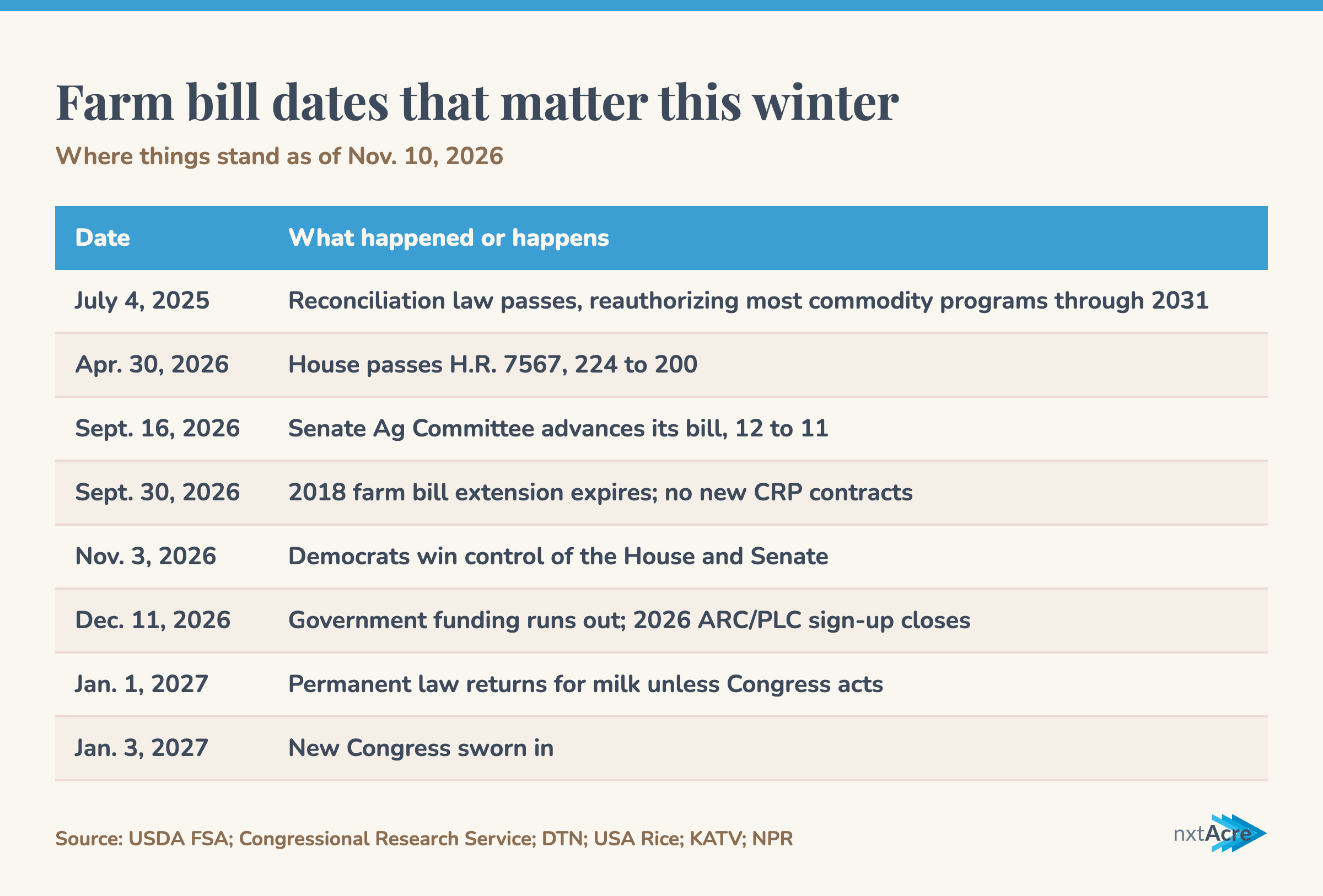
The one date to circle if you milk cows is Jan. 1. Under current law, the suspension of the 1938 and 1949 permanent farm laws for milk runs only through Dec. 31, 2026 (CRS comparison of H.R. 7567). DTN calls the return to those old laws the expiration "most often discussed," because it could set support prices well above market levels, particularly for dairy. That's the dairy cliff.
Where do the House and Senate farm bills stand?
Each chamber has its own bill, and neither has passed the other chamber. The House passed H.R. 7567, the Farm, Food, and National Security Act of 2026, on April 30 by a vote of 224 to 200. The Senate Agriculture Committee's first try failed 10 to 11 on Aug. 6 over SNAP (DTN). On Sept. 16 the committee advanced its bill on a 12-11 party-line vote, and it went to the full Senate as S. 5526.
It still needs 60 votes on the Senate floor. "We'll have to do with the Democrats to get 60 votes to get the bill out," Sen. Chuck Grassley told DTN. When both chambers returned on Nov. 9, DTN counted roughly 20 scheduled legislative days left in the year.
In a Nov. 10 RFD-TV report, Senate Ag Chairman John Boozman sounded hopeful and worried at once. "We're close, and I think that we've got an excellent chance of getting this done," he said, adding that staff for the chairs and ranking members of the House and Senate ag committees were meeting to work out the differences. He also said, "If we're not careful, we're going to lose the farm bill, not get it done."
Why is SNAP holding up the farm bill?
Because the 2025 law shifted part of SNAP's cost to the states, and the two parties disagree on how long to put it off. Under current law, states with payment error rates of 10% or more start paying 15% of benefit costs on Oct. 1, 2027. The Senate committee bill pushes the start back one year, to Oct. 1, 2028, and the House bill leaves current law alone (CRS). Democrats want a two-year delay, and DTN found "no public statements or indications" they're willing to move off it.
Conservation changes and mandatory country-of-origin labeling are still being negotiated too, DTN reports, and year-round E15 and California's Proposition 12 keep coming up on the Senate side.
Then there's the calendar. Government funding runs out Dec. 11, and DTN reports a farm bill could ride on a continuing resolution or an omnibus spending package. The Nov. 3 election also changed the math: Democrats won control of both the House and the Senate, NPR reported, and the new Congress is sworn in Jan. 3. DTN wrote that Republicans now face "a ticking clock and the prospect of handing over control of Congress," while Democrats' better-than-expected night may harden their position on SNAP. There's a precedent. In 2018, Democrats flipped the House, and the Republican-controlled Congress passed that year's farm bill in December, during the lame duck.
What changes on your farm if it passes, and if it doesn't
If you raise corn, beans or wheat on base acres and don't have land in CRP, the core of your safety net doesn't hinge on this deal. ARC, PLC and the higher reference prices are set through crop year 2031, and federal crop insurance is permanently authorized.
A few groups have more riding on it. Here's what the House bill would do for them, per the CRS comparison:
- Dairies: H.R. 7567 would extend the permanent-law suspension for milk through Dec. 31, 2031, make the Dairy Forward Pricing Program permanent and extend the Dairy Indemnity Program through Sept. 30, 2031.
- Specialty crop growers: USDA would set up a framework for payments after events like market disruptions, with a separate payment limit of not less than $900,000 for entities that get 75% of their average gross income from farming. The bill doesn't say where the money would come from.
- Orchards and vineyards: the Tree Assistance Program would cover biennial tree crops and losses to pest infestations, and allow an initial partial payment.
- Anyone with a marketing loan: the bill lets you repay it during a lapse in appropriations, when USDA staff may be furloughed.
For CRP landowners, or anyone hoping to enroll ground, the answer is simpler. New contracts can't be approved until Congress passes a farm bill or an extension (DTN).
What to do now, whatever Congress does
Sign your 2026 ARC/PLC contract. The deadline is Dec. 11, the same day as the funding deadline, and it has nothing to do with the farm bill. If you don't sign by then, FSA keeps your 2025 election on file but the farm is ineligible for 2026 payments. You have to enroll every year, or sign the new multi-year contract that runs 2026 through 2031.
Look at your 2025 money, too. FSA paid 2025 ARC and PLC at the higher of the two programs, with the payment run around Oct. 8, 2026. Final 2025 PLC rates were 26 cents a bushel for corn, 21 cents for soybeans and $1.29 for wheat (FSA). If you're on the cash method, you generally report income in the year you receive it, and program payments go on Schedule F line 4a. USDA may send you a CCC-1099-G showing them (IRS Schedule F instructions).
nxtAcre's Tax Center builds the Schedule F worksheet from your books, puts program payments on line 4a, and lists the 1099-G or CCC-1099-G you should expect on your year-end checklist so you can match it before your preparer asks.
If you have CRP acres coming out of contract, call the county office now rather than in January. They can tell you which of the limited post-Sept. 30 actions apply to your contract.
Questions and answers
Is the farm bill expired right now?
Yes. The last extension of the 2018 farm bill ran out on Sept. 30, 2026. But the 2025 reconciliation law already reauthorized most commodity programs through crop year 2031, and crop insurance is permanently authorized.
Will ARC and PLC still pay for the 2026 crop?
Yes, if a payment triggers and you enroll by Dec. 11, 2026. Those programs were reauthorized through the 2031 crop year in the 2025 law. According to farmdoc daily, any 2026 payment would not arrive until October 2027.
Can I sign up new land for CRP?
Not right now. FSA has no authority to approve new CRP contracts after Sept. 30, 2026, until Congress passes a farm bill or an extension. Ask your county FSA office what it can still do on existing contracts.
What is the dairy cliff?
It's what happens if the suspension of the 1938 and 1949 permanent farm laws runs out. Those laws could set dairy support prices well above market levels. The suspension for milk ends Dec. 31, 2026, and the House-passed bill would extend it through 2031.