The farm "death tax" cliff that was coming in 2026 didn't happen
Published · 3 min read
For a few years, a lot of farm families had Jan. 1, 2026 circled on the calendar. That was the day the federal estate and gift tax exemption was scheduled to fall back toward its older level, somewhere around $5 million a person plus inflation, down from $13.99 million in 2025. When most of what you own is ground and iron, cutting that number that hard was a real worry.
What actually changed
The drop didn't happen. The One Big Beautiful Bill Act set the exemption at $15 million per person as of Jan. 1, 2026, and it wrote it in with no sunset date, which is different from the last couple of tax laws that came with a built-in expiration, according to the law firm Morgan Lewis. Without the new law, that same firm notes, the exemption had been slated to revert to the pre-2017 level of $5 million a person, plus annual inflation adjustments.
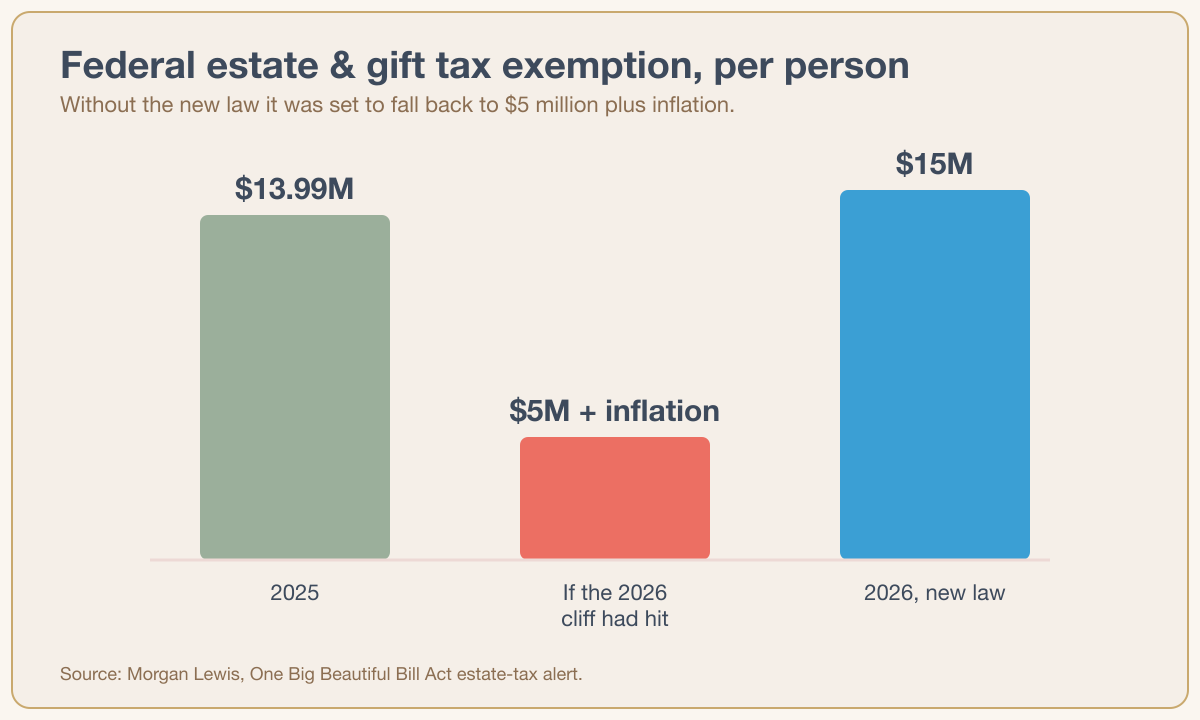
In plain terms, a single person can generally pass about $15 million before the federal estate tax applies, and a married couple can shelter roughly $30 million between them, with the figure indexed for inflation going forward, per Penn State Extension.
Three reasons not to relax all the way
For most family farms, that takes the federal estate tax off the front burner. But off the front burner isn't gone, and there are three things worth keeping in mind before anybody exhales too hard.
- Land values keep climbing. A place that sits comfortably under $15 million today can cross it in a decade without the family buying another acre, just on ground going up. The exemption is indexed for inflation, but farmland doesn't always move with inflation.
- This is the federal number only. Several states run their own estate or inheritance taxes with much lower thresholds, and this law doesn't touch those. Where you farm matters.
- No sunset doesn't mean no change ever. A later Congress can rewrite it. In tax law, permanent means until it isn't.
The part an exemption number can't fix
The estate tax was never the only reason to have a succession plan. Who runs the place, who gets the ground versus who gets bought out, how the kid who stayed and the kids who left are treated fairly, how a lender reads the balance sheet when the operator dies. None of that is solved by an exemption figure. It gets solved by writing things down early and keeping your records straight, meaning what you own, what you paid for it, and what it's worth now.
That last part is where clean books earn their keep. nxtAcre's fixed-asset records hold each asset's cost and in-service date next to the machine or parcel, so an estate attorney isn't starting from a shoebox when the time comes. Cheaper for the family, and a lot less ugly.
We can't tell you how your state stacks on top of the federal rules, so treat this as the lay of the land, not a plan. Sit down with an estate attorney and a CPA who know farm transfers before you act on any of it.
This article is general information, not tax or legal advice. Confirm how it applies to your farm with your own professionals.
Questions and answers
Do most family farms owe federal estate tax now?
At a $15 million per person exemption, far fewer do. Large multi-generation operations can still exceed it, and land values keep rising, so run your own numbers with a professional.
Is the $15 million exemption permanent?
The law was written with no sunset date, unlike the previous increase, according to Morgan Lewis. A future Congress could still change it.
Does this cover my state's estate tax?
No. This is the federal exemption only. Several states have their own estate or inheritance taxes with much lower limits, and this law does not change them.