Electronic ear tags are now required to move some cattle across state lines. Good idea or overreach?
Published · 4 min read
If you haul breeding cattle across a state line, a USDA rule that took effect Nov. 5, 2024 already touches you, and plenty of ranchers are still fuming about it. Certain classes of cattle and bison now have to wear an electronic identification ear tag, an EID tag, to move interstate. Here's what it actually says, and why it's one of the hotter arguments in the cow business.
Who it covers
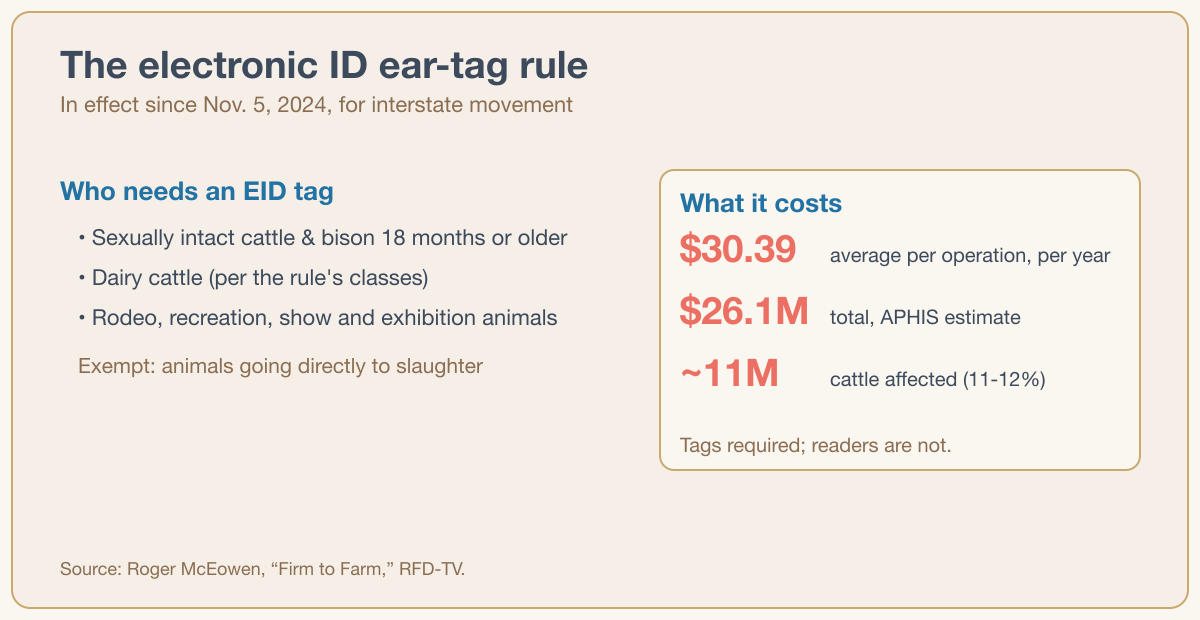
The rule applies to animals moving across state lines in these groups, as laid out in an analysis by ag law professor Roger McEowen for RFD-TV: all sexually intact cattle and bison 18 months of age or older, all female dairy cattle of any age plus male dairy born after March 11, 2013, and any cattle or bison used for rodeo, recreation, shows or exhibitions. Animals going straight to slaughter are exempt. (RFD-TV)
A key point that cools some of the heat: the rule doesn't widen which animals need a tag beyond the older 2013 rule. It changes the kind of tag. And an animal already carrying an official tag from the 2013 rule can keep that device for the rest of its life.
What it costs, and what it doesn't
According to the same analysis, APHIS pegged the total cost at about $26.1 million, an average of $30.39 per operation per year, with the tag purchase being the only added expense. Just as important, producers have to buy the tags but are not required to buy or use electronic readers. The tag is electronic, but whether anybody actually scans it is left to the industry.
For scale, the analysis estimates the rule affects roughly 11 million cattle, about 11 to 12% of U.S. inventory, and notes that pulling feeder cattle in under a future rule could push that toward 36 million.
Why USDA says it's needed
The government's case is disease traceability. APHIS argues electronic tags improve its ability to trace the cattle and bison that already have to be identified, so that if a foreign animal disease shows up, it can find exposed animals faster and keep an outbreak from spreading nationwide. The agency has also called the tags important to reopening export markets. With New World screwworm active in several states, that speed-of-tracing argument isn't abstract right now.
Why a lot of ranchers push back
The pushback runs on a few tracks. Some say the old metal visual tags traced disease just fine and the mandate solves a problem that wasn't there. Some don't like being required to buy anything, small cost or not, as a matter of principle, and worry about where animal-movement data ends up and who sees it. The fight reached Congress, where the RFD-TV analysis notes Sen. Mike Rounds introduced a bill to block any mandatory EID rule and Rep. Harriet Hageman moved to overturn it, with other senators pushing a resolution of disapproval. That analysis was written in mid-2024, and none of those efforts stopped the rule, which has been in force since November 2024. The fight has since moved to court. A group of ranchers and cattle organizations, represented by the New Civil Liberties Alliance and including R-CALF USA, sued USDA in federal court in South Dakota. The judge refused USDA's request to dismiss the case in September 2025, per Western Livestock Journal, and in March 2026 the ranchers asked the court to throw the rule out, per Rural Radio Network. That was the latest we could find, so check for a ruling before you plan around one.
So it comes down to a real values question, not a technical one. Is a cheap electronic tag a sensible insurance policy against a disease wreck that could shut the whole industry down, or is it the federal government putting a tracker in your cattle over a problem the old system handled? Ranchers we'd trust come down on both sides.
Whatever you think of it, if you move breeding stock interstate you need the right tags, and you need to know each animal's official ID. Recording that number against the animal in nxtAcre keeps your identification straight when it's time to fill out the paperwork.
Tell us where you land: necessary disease protection, or federal overreach?
Questions and answers
When did the electronic ID ear tag rule take effect?
The rule took effect Nov. 5, 2024. It requires certain classes of cattle and bison to carry an electronic ID tag to move across state lines.
Which cattle need an electronic ID tag?
For interstate movement: all sexually intact cattle and bison 18 months or older, all female dairy cattle plus male dairy born after March 11, 2013, and cattle or bison used for rodeo, recreation, shows or exhibitions. Animals going directly to slaughter are exempt.
Do I have to buy a tag reader?
No. According to the RFD-TV analysis, producers must buy the tags but are not required to purchase or use electronic readers. Whether tags are scanned is left to the industry.
Why are some ranchers against the EID rule?
Objections include the cost and principle of a federal purchase mandate, concerns about where animal-movement data goes, and the view that older visual tags already traced disease adequately. Lawmakers tried to block it, and ranchers have challenged it in federal court.