China left U.S. soybeans off its tariff cuts. Now what?
Published · 7 min read
Did China cut tariffs on U.S. soybeans?
Not on whole beans. On Sept. 28, China's commerce ministry released a list of more than 1,600 U.S. products for possible tariff cuts, DTN reported. Agri-Pulse counted 1,619 items, including cattle, pigs and chicken, beef and pork products, and a list of fruits and vegetables. On soybeans the two reports don't line up neatly. DTN said soybeans for food and crushing were excluded. Agri-Pulse said soybean seed, flour, oil, cake and residues are on the list.
Either way, commercial soybeans were left out, and U.S. beans still face a 13% import tariff in China, including an additional 10% levy, S&P Global reported. Brazilian beans pay the 3% most-favored-nation rate. Bloomberg reported that the timing of the cuts that were announced remains unclear, because both countries first have to finish procedures required under their own laws.
The American Soybean Association was disappointed by the exclusion, Reuters reported. "Removing the tariff would improve the competitiveness of US soybeans," ASA said. Traders had already warned Reuters that the extra 10% is too high for private crushers to absorb.
How many U.S. soybeans has China bought?
Around 15 million metric tons as of Oct. 16, by Reuters' count, against the 25 million-ton purchase target the White House announced for the 2026/27 marketing year, Farm Policy News reported. That week, Bloomberg reported, state-owned companies booked at least 20 cargoes, about 1.3 million tons, mainly loading December through March.
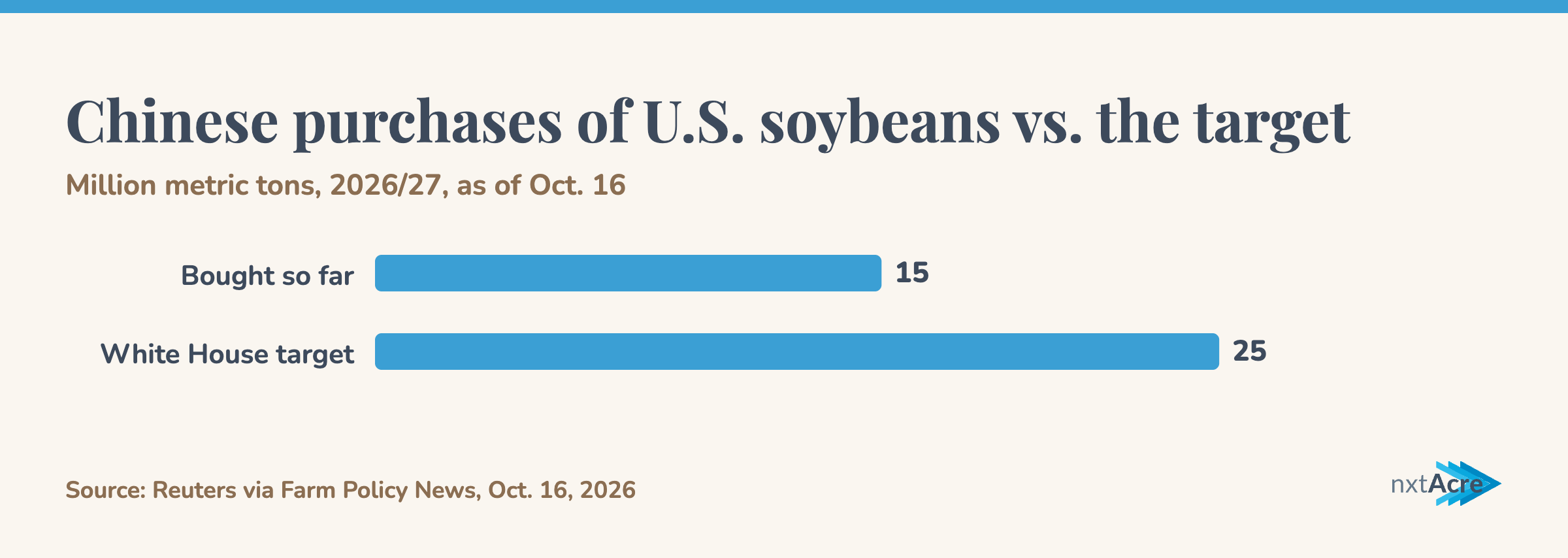
Be careful with any single tally. For that same week, Reuters' own calculations came out at 18 to 23 cargoes, or roughly 1.2 to 1.5 million tons. Ask how a number was counted before you trade on it.
The commitment is meant to repeat. Back in June, U.S. officials told Brownfield the target was 25 million tons a year through 2028, and USDA Deputy Secretary Stephen Vaden said "every point of indication we have indicates they're going to meet that 25 million metric ton this year and going forward." So far, though, the October buying Farm Policy News rounded up was by state-owned companies.
What did the October WASDE say about soybeans?
USDA's Oct. 9 WASDE nudged the U.S. crop up and left the price alone. Yield went to 53.1 bushels an acre, up 0.3 from September, putting production at 4.56 billion bushels on unchanged harvested area of 85.9 million acres. Exports were raised 10 million bushels to 1.695 billion, crush stayed at 2.78 billion, and ending stocks rose 5 million bushels to 315 million. The season-average farm price stayed at $12.00.
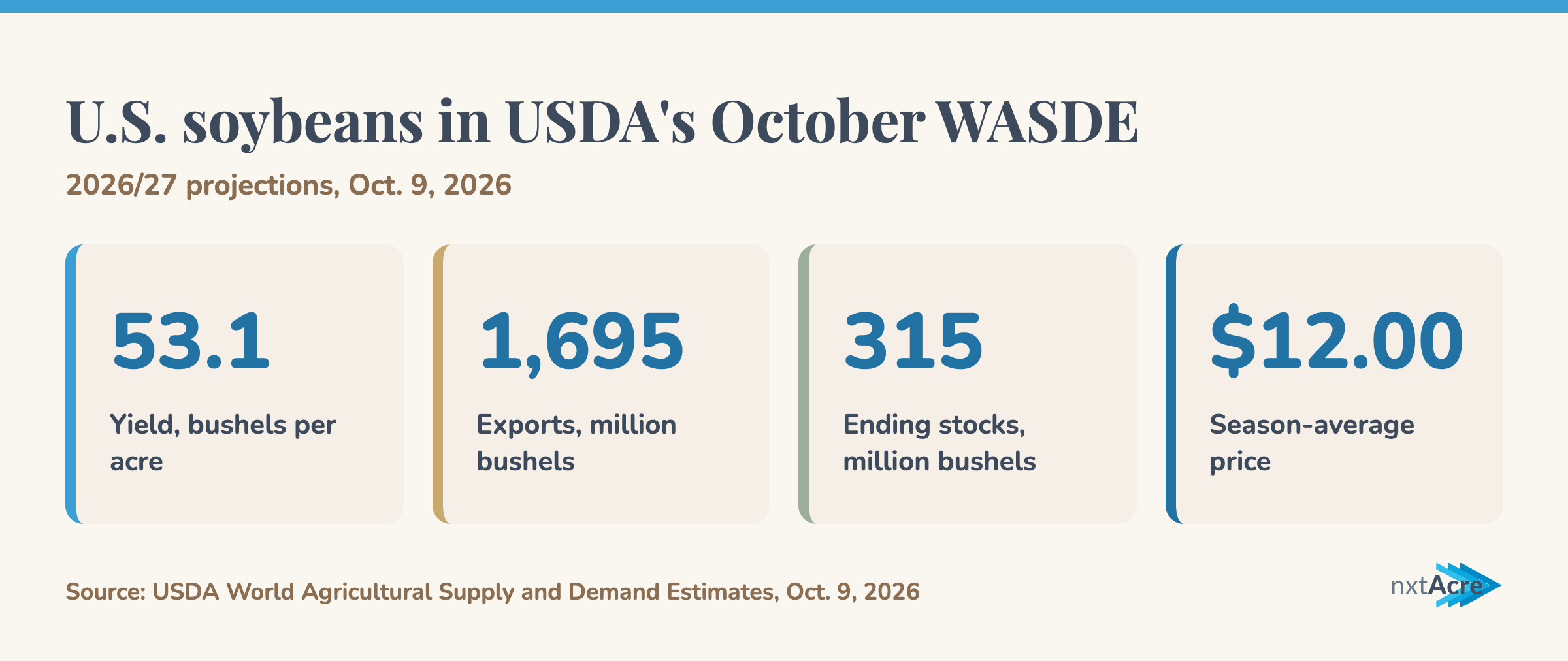
For context, the same report puts U.S. exports at 1.515 billion bushels in 2025/26 and 1.892 billion in 2024/25. It projects China's total 2026/27 soybean imports at 115 million metric tons, so the U.S. target is a slice of a much bigger market. And it puts Brazil's 2026/27 crop at 186 million tons, up from 180.5 million, with 118 million tons of exports.
One more number. AFBF's March estimate of the effective PLC reference price for 2026 soybeans is $10.71 a bushel, and PLC pays only when the national marketing-year average price falls below it. At USDA's $12.00 forecast it wouldn't. If you were counting on a program payment to backstop unpriced bushels, that forecast says don't.
Should I store soybeans or sell them now?
It depends on whether the market pays you to wait. The farmdoc daily studies measure it simply: the price gain from harvest to the month you sell, minus the cost of holding, which is physical storage plus the interest you give up or pay on the value of the beans. If the gain on offer doesn't cover that, storing unpriced beans is a bet on higher futures. That can be a fair bet. Just call it what it is.
History isn't generous. Carl Zulauf's study of returns since 1973 found that the net return to cash storage of soybeans didn't differ statistically from zero for any of the storage periods through June, and that cash storage after June is generally not profitable. Unhedged soybean storage to April, May and June did return more than 3% of the October price on average, which the study says may have economic significance. Hedged storage never averaged above zero.
The companion study by Zulauf, Nick Paulson and Joe Janzen found that total soybean storage cost averaged 11% of the October price, from a low of 3% in 2012 to a high of 21% in 1981. Since 2020, both physical storage cost and interest cost have gone up.
If you've already sold most of your beans, none of this changes much for you. It matters for the bushels still sitting unpriced.
What does it cost to store beans this year?
Get your elevator's actual rate, but here's a current benchmark. Eric Richer, a farm management field specialist with Ohio State University Extension, wrote on Sept. 23 that Ohio custom farm rate surveys put commercial storage at about 11 cents a bushel a month and on-farm storage at about 5 cents.
Those are the physical costs. Add interest at your operating rate on today's cash value of the beans, whether you borrow against them or not, since that money could be paying down the line. Then set the total against what the market is offering: the futures spread from the nearby contract to the month you'd deliver, plus any improvement in the basis bid for that month over today's. If the offer is smaller than the cost, the difference is the price bet you'd be making.
What could change the picture?
A few things, and nobody knows yet which way they'll break. The U.S.-China trade truce was extended to Jan. 10, DTN reported, so watch what happens around that date. Watch whether the announced tariff cuts actually take effect, and whether whole soybeans get added later. Watch weekly export sales for China.
USDA's next two WASDE reports come out Nov. 10 and Dec. 10, and either can move the balance sheet. The cargoes China booked in mid-October mostly load December through March. Brazil's next crop, at USDA's 186 million tons, is the competition, and it pays the lower tariff.
What we'd do before the Nov. 10 report
Start with your breakeven per bushel from your own costs and yields, not the price you wish you had. nxtAcre's Profitability report shows cost per acre by field and crop from your books, so you can see that number for each field instead of guessing at a farm average.
- Get basis bids for nearby and spring delivery from two or three buyers, not just one.
- Ask your elevator for its storage rate, and price out your own bin, interest included.
- Price a slice of the unpriced bushels if the carry and basis don't cover storage.
- Set target orders above the market for another slice, so you aren't watching screens all winter.
- Put Nov. 10, Dec. 10 and Jan. 10 on the calendar.
The CME soybean futures quotes in nxtAcre show the next several contract months, which is what you need for checking the spread when you sit down to make the call.
Questions and answers
Why did China leave soybeans out of its tariff cuts?
The reporting we found doesn't give an official reason. What's clear is the effect: traders told Reuters the extra 10% is too high for private Chinese crushers to absorb, and the buying reported in October came from state-owned companies. The American Soybean Association said removing the tariff would make U.S. beans more competitive.
Will there be a PLC payment on 2026 soybeans?
Not at USDA's current forecast. AFBF estimates the effective reference price at $10.71, and USDA's October forecast for the season-average price is $12.00. PLC pays only if the national marketing-year average price ends up below the reference price, and that average isn't final until the marketing year is over.
Is it cheaper to store soybeans on farm or at the elevator?
Ohio survey figures cited by Ohio State Extension put on-farm storage at about 5 cents a bushel a month and commercial at about 11 cents. Interest on the value of the beans is the same either way, and the farmdoc daily research counts it as part of the cost of storage.
When is the next WASDE report?
USDA's next WASDE comes out Nov. 10, 2026, followed by Dec. 10. Monthly reports in 2027 start Jan. 12.