The herd is the smallest in 75 years and prices are at records. Do you expand or cash in?
Published · 4 min read
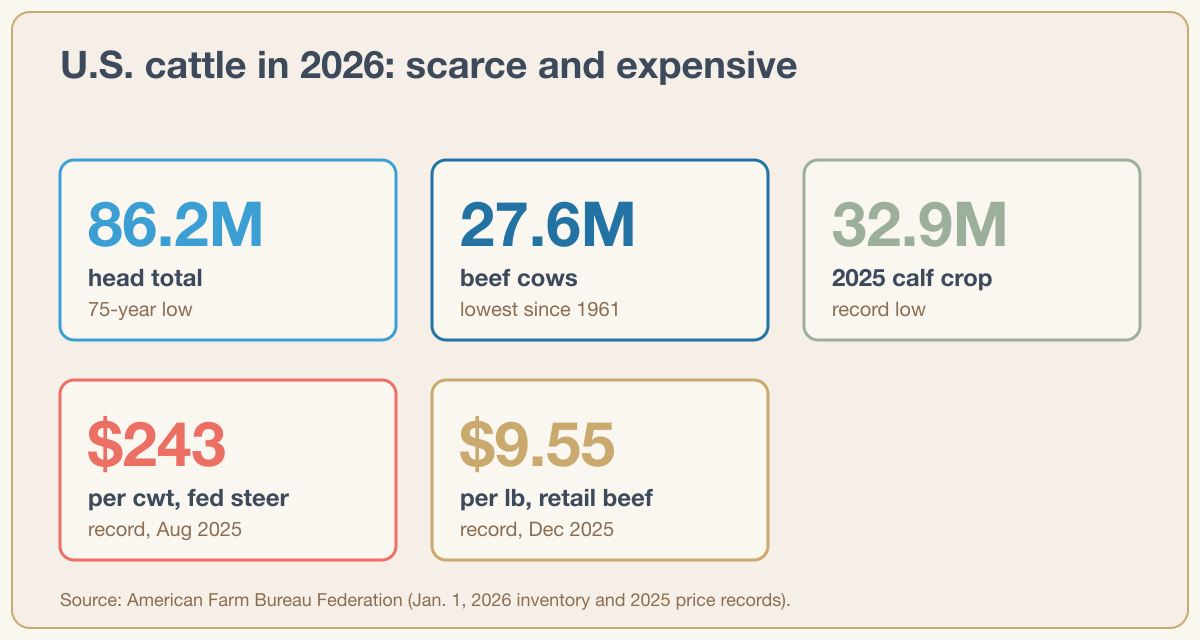
The math on cattle right now is strange. There are fewer of them than at almost any point in living memory, and they're worth more than they've ever been. On Jan. 1, 2026 the U.S. cattle herd stood at 86.2 million head, down 300,000 from a year earlier and what the American Farm Bureau Federation calls a 75-year low. (Farm Bureau)
How small, exactly
The beef cow herd, the mama cows that make next year's calves, came in at 27.6 million head, down 1% from the year before and the lowest since 1961, per the same Farm Bureau analysis. The 2025 calf crop was 32.9 million head, down about 2%, which it calls a record low and the second year in a row to set one. Fewer cows making fewer calves is a hole you don't climb out of in one season.
The prices on the other side of that
Tight supply has done what tight supply does. Farm Bureau reports the five-market average for fed steers hit a record $243 per hundredweight in August 2025, and the composite all-fresh retail beef price set a record of $9.55 a pound in December 2025. There was a wobble late in 2025, when cash cattle dropped 13% to a low of $207 on Nov. 28, 2025 before recovering all of it, a reminder that a market this tight can swing hard in both directions.
The bet every cow-calf operator is making
Here's the hard part, and it's the oldest argument in the cattle business. When prices are this good, the instinct is to hold back heifers, grow the herd, and sell into the strong market for years. There are early signs some folks are doing exactly that: Farm Bureau notes replacement heifers rose 1% to 4.71 million and heifers expected to calve rose 1%, which it calls one of the first steps of expansion, though it stops short of saying the herd has turned.
But every heifer you keep back to breed is a heifer you didn't sell at today's record price. And Farm Bureau doesn't expect the herd to actually expand until at least 2028, so by the time her calves reach the market the price may not look anything like it does now. That's the cattle cycle in one sentence: everybody expanding at the top is how the top ends. Hold back and build, or sell into strength and keep the powder dry, is a bet with real money on both sides, and reasonable operators land in different places.
One more thing weighing on supply: when Farm Bureau ran these numbers in February, the Mexico border was closed to imported cattle over New World screwworm, and it said that would keep feeder prices elevated in 2026 and 2027. USDA has since started reopening southern ports to Mexican cattle one at a time, per its screwworm status page.
How to make the call for your own place
The honest answer is that nobody can time this for you, and anybody who says they can is guessing. What you can do is know your own cost of production per head, so you're deciding on your real numbers instead of the sale-barn mood. nxtAcre's enterprise reporting breaks income and expense down by herd per head, which tells you what it actually costs you to carry a cow and raise a calf. From there, whether to expand is a decision you make with numbers, not nerves.
So we'll put it to the room: with the herd this small and prices this high, are you keeping heifers back to build, or selling into it while it's hot?
Questions and answers
How small is the U.S. cattle herd in 2026?
The Jan. 1, 2026 inventory was 86.2 million head, down 300,000 from the prior year. Farm Bureau describes it as a 75-year low. The beef cow herd of 27.6 million was the smallest since 1961.
Why are cattle prices so high?
Supply is tight. With fewer cattle, fed steers set a record $243 per hundredweight in August 2025 and retail beef hit a record $9.55 a pound in December 2025, according to Farm Bureau.
Is the cattle herd going to expand?
There are early signs. Farm Bureau notes replacement heifers rose 1%, which it calls a first step of expansion, but it does not expect inventory to expand until at least 2028.
Should I keep back heifers or sell into the high market?
There's no one right answer. Holding heifers builds the herd but means forgoing today's record prices, and prices may be lower by the time their calves sell. Knowing your cost of production per head helps you decide on your own numbers.