Should you buy equipment before Dec. 31 to cut your taxes?
Published · 7 min read
Should you buy equipment before Dec. 31 just to save taxes?
Probably not, unless you were going to buy it anyway. With about nine weeks left in 2026, this is when the dealer calls with a year-end price and somebody at the elevator says he bought a tractor so he wouldn't "give it to the government."
He's skipping a step. A deduction doesn't give you back the dollar you spent. It gives you back the tax you would have paid on that dollar, at your income tax rate plus self-employment tax on farm profit. You're still out the rest, and if you borrowed it, you're paying interest on the whole amount. Farm operating loans averaged 7.12% in the second quarter, according to the Chicago Fed's August AgLetter.
It's not a year for guessing, either. USDA's September forecast has 2026 net farm income down 5.5% from 2025 after inflation. Lenders in that Chicago Fed survey expected farm machinery loan volume in the third quarter to come in below a year earlier.
None of that means don't buy. If the combine really needs replacing, the 2026 rules are generous. Let the machine decision drive the tax decision, not the other way around.
What are the Section 179 and bonus depreciation limits for 2026?
For tax years beginning in 2026, you can expense up to $2,560,000 of qualifying property under Section 179, and that limit drops dollar for dollar once you place more than $4,090,000 of Section 179 property in service during the year. Both figures are in Rev. Proc. 2025-32. For 2025 the limits were $2.5 million and $4 million (IRS Pub. 946).
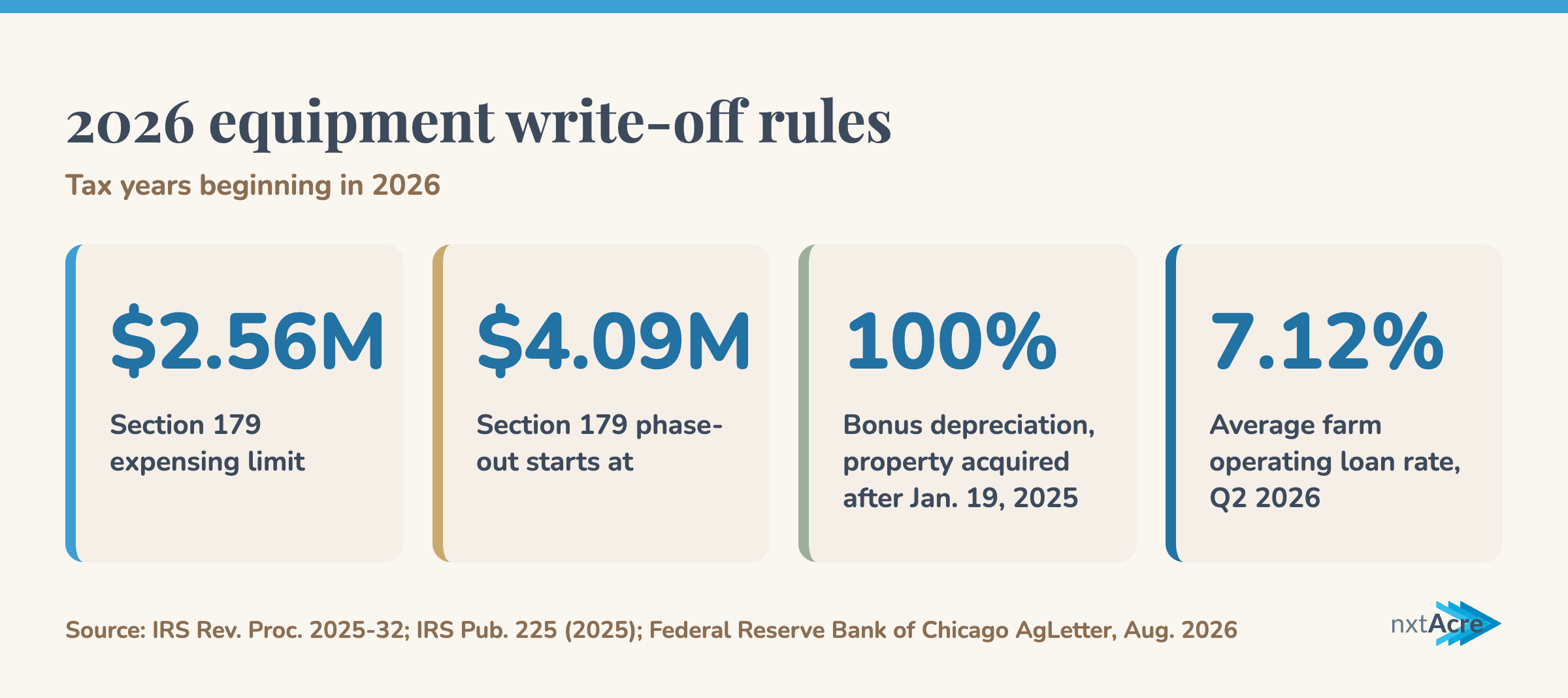
Bonus depreciation, which the IRS calls the special depreciation allowance, is back at 100% for qualified property acquired and placed in service after Jan. 19, 2025 (IRS Pub. 225). The IRS's Notice 2026-11 describes it as a permanent 100% first-year deduction. Pub. 946 says you must take it unless you elect out.
Penn State Extension counts the Section 179 expansion among the most farmer-friendly changes in the 2025 tax law. If you aren't anywhere near $4 million of purchases in a year, though, the dollar cap isn't what holds you back. Your income, your cash and your lender are.
Does the equipment have to be delivered by Dec. 31?
Yes. It has to be placed in service, which Pub. 946 defines as ready and available for a specific use. An order, a deposit or even payment in full in December doesn't count if the machine isn't on your place and ready to go.
The farm example in Pub. 225 is a planter. Delivered and assembled in December after harvest, it's in service that year even though it won't plant a seed until spring. Delivered in December but not put together until February, it's in service the following year. If the dealer promises a combine "before the end of the year," get the delivery date in writing. A unit still on the dealer's lot on Dec. 31 is a 2027 deduction.
Used equipment qualifies. Pub. 225 says new or used equipment you buy during the year qualifies for Section 179, and Pub. 946 says bonus property can be new or certain used property. Watch who you buy from, though. Property bought from your spouse, your ancestors or your lineal descendants isn't treated as a purchase for Section 179. Pub. 225's own example: a tractor bought from your sibling qualifies, and one bought from your parent doesn't. That matters when the next generation is buying Dad's line of equipment.
What if the write-off is bigger than this year's income?
Section 179 stops at your income. After the dollar limit, the deduction can't exceed your taxable income from businesses you actively run, and for this purpose that includes wages you, or your spouse on a joint return, earn as an employee (Pub. 225). Whatever doesn't fit carries to the next year.
Pub. 225 walks through it. Last year you placed a $100,000 machine in service and elected to expense all of it, but your business taxable income was $80,000, so the deduction was limited to $80,000 and $20,000 carried over. This year you buy a $110,000 machine and have $125,000 of business taxable income. You deduct the full $110,000 but only $15,000 of the carryover, and the last $5,000 rolls to next year.
Bonus depreciation works by property class, not by machine. Pub. 225 says you can elect out of the allowance for any class, but the election covers all property in that class placed in service that year. New farm machinery and equipment is 5-year property and used farm machinery is 7-year, according to the same publication's recovery-period table. So two used machines bought the same year go together.
If your deductions add up to more than your income, you may have a net operating loss. Pub. 225 says farming losses that create an NOL may be carried back 2 years and carried forward indefinitely, so a 2026 farm loss can reach back to your 2024 return. It only goes so far, though. The 2025 Schedule SE instructions leave net operating losses from other years out of self-employment earnings, so a carried loss doesn't touch the SE tax you paid in a good year.
What happens when you sell or trade a machine you wrote off?
You pay it back as ordinary income. When you sell depreciated equipment, the part of the gain treated as ordinary income is the smaller of the depreciation you took (Section 179 included) or the gain itself (Pub. 225).
Pub. 225's example is a farm pickup. It cost $30,000, took $18,480 of MACRS depreciation over three years and sold for $21,000. Adjusted basis was $11,520, the gain was $9,480, and all $9,480 was ordinary income because it was less than the depreciation taken. Expense a machine to zero and the whole sale price can come back that way.
Trade-ins don't get around it. Pub. 225 says that under the Tax Cuts and Jobs Act, tractors and equipment no longer qualify for a like-kind exchange, and the trade value is subject to depreciation recapture as if cash changed hands. Trading a written-off combine toward a new one is a sale of the old one.
One point in expensing's favor: the same Schedule SE instructions leave gains from selling property that isn't inventory, or held for sale to customers, out of self-employment earnings. The depreciation came off Schedule F, but the recapture shows up as ordinary income without self-employment tax on it. That's a fair reason to time a purchase you already need.
What we'd do before Dec. 31
- Get a year-to-date 2026 profit number and an honest guess at 2027 before you talk to the dealer.
- Ask your preparer how much taxable income to leave on the 2026 return, and expense to that number instead of to zero.
- If you buy, get a written delivery date and make sure the machine is set up and ready to run by Dec. 31.
- Write down what your trade-in is worth and how much depreciation is left on it, so the recapture doesn't surprise you at tax time.
nxtAcre's fixed-asset register can link each asset to its equipment record and keeps a MACRS or straight-line schedule for it, so cost, depreciation taken and remaining basis are in one place when you're deciding whether to trade. Your preparer can see the same numbers through a view-only accountant login.
This article is general information, not tax advice. Confirm how it applies to your farm with your tax preparer.
Questions and answers
Can I take Section 179 on equipment I ordered but haven't received?
No. The deduction depends on when the machine is placed in service, meaning ready and available for a specific use. Paying in December doesn't help if it shows up in January.
Does used equipment qualify for 100% bonus depreciation in 2026?
It can. Pub. 946 says qualified property acquired and placed in service after Jan. 19, 2025, can be new or certain used property. For Section 179, equipment bought from your spouse, a parent or grandparent, or a child or grandchild isn't treated as a purchase.
What happens to a farm loss in a year I write off a lot of equipment?
If your deductions are more than your income, you may have a net operating loss. Pub. 225 says a farming loss that creates an NOL may be carried back 2 years and carried forward indefinitely. It won't reduce self-employment earnings in the years it's used.
Does financing the machine change the deduction?
No. Pub. 946 says the cost of property you buy includes what you pay in cash and in debt obligations. On the cash method, Pub. 225 says you can generally deduct the interest in the year you pay it.