ARC-CO or PLC for 2026: working the numbers before Dec. 11
Published · 7 min read
When is the ARC/PLC deadline for 2026?
Friday, Dec. 11, 2026. Sign-up opened Sept. 16, and you can enroll online with a Login.gov account or by appointment at your county FSA office (DTN). A separate window for the 2027 crop opened Nov. 2 and runs to March 15, 2027.
Missing Dec. 11 costs real money. Per FSA, if you don't submit a 2026 election, the farm keeps its 2025 election but is ineligible for payments for the 2026 program year. You have to enroll through a signed contract every year, though you can sign one multi-year contract covering 2026 through 2031.
This year also works differently from last. For 2025 only, FSA paid the higher of PLC or ARC-CO on each base crop regardless of what you elected (FSA fact sheet), with the payment run around Oct. 8, 2026. That safety valve is gone. For 2026 you live with your choice, and any payment it triggers won't reach you until October 2027, farmdoc daily notes.
Where prices sit against the reference prices
For corn and soybeans, USDA's latest numbers sit above the PLC line. The Oct. 9 WASDE raised the national corn yield 2.7 bushels to 181.2 and lowered the projected 2026-27 season-average price 10 cents to $4.70. Soybeans held at $12.00. Wheat dropped 10 cents to $6.30, and sorghum fell to $4.50 from $4.60.
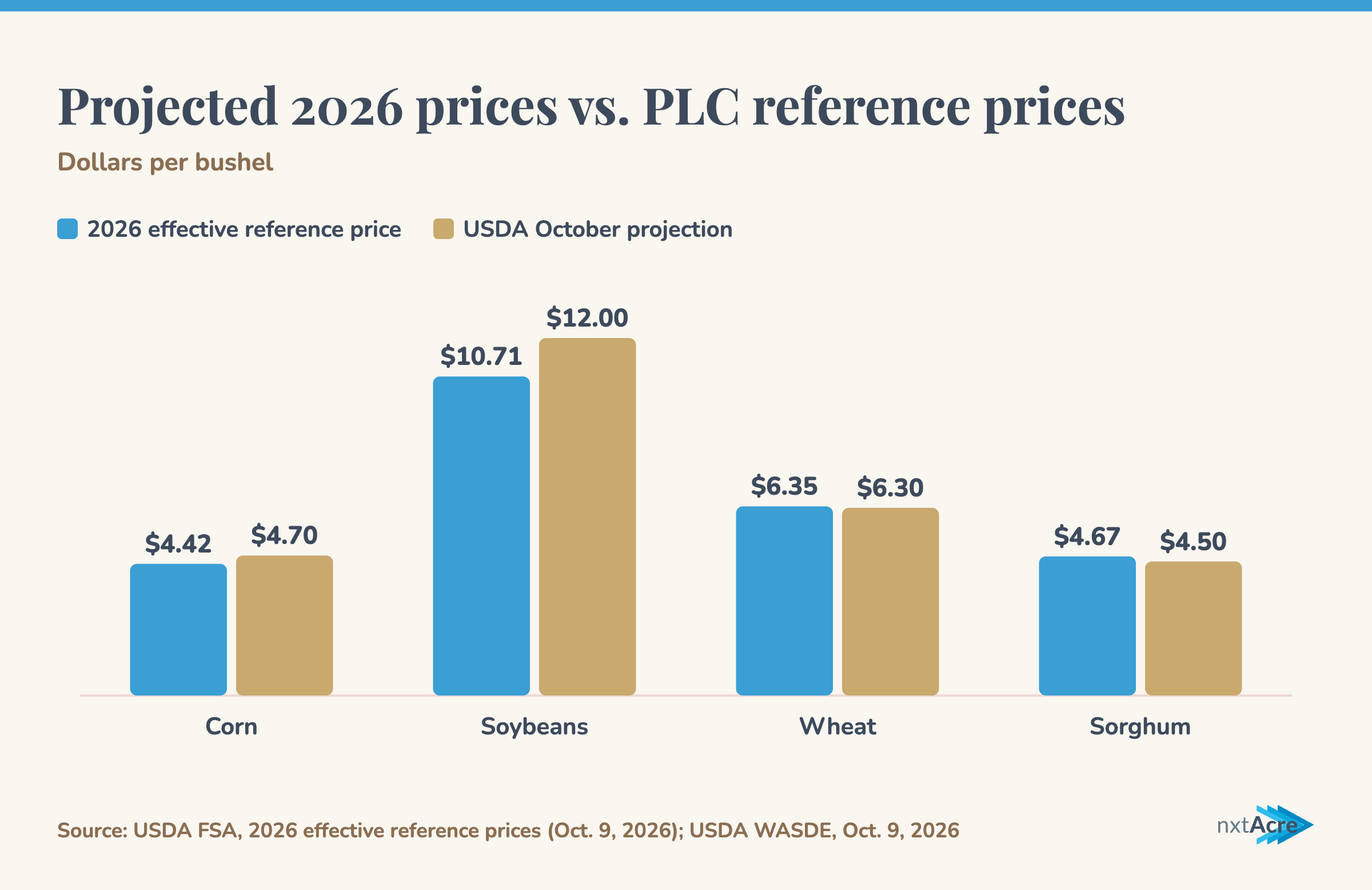
Set those against FSA's 2026 effective reference prices: $4.42 for corn, $10.71 for soybeans, $6.35 for wheat and $4.67 for sorghum. PLC pays only when the effective price, the higher of the season-average price or the loan rate, ends below the reference price. Corn has 28 cents of cushion and beans have $1.29. Wheat is 5 cents under and sorghum 17 cents under.
These are projections. The corn and soybean marketing year runs Sept. 1 through Aug. 31, so the final 2026 price won't be set until after Aug. 31, 2027. USDA's next two WASDE reports come out Nov. 10 and Dec. 10, the second one the day before the sign-up closes.
How do ARC-CO and PLC payments work?
PLC pays on price alone. When the effective price falls below the effective reference price, the difference is paid on 85% of the farm's base acres for that crop (FSA fact sheet), using the farm's own PLC program yield (Mississippi State Extension). What you actually harvest doesn't enter into it, and you don't even have to plant the crop.
ARC-CO pays on county revenue. FSA multiplies a five-year Olympic average of the national price by a five-year Olympic average county yield to get benchmark revenue, and the guarantee is 90% of that. If the county's actual yield times the season-average price comes in under the guarantee, the difference is paid on 85% of base (FSA). The 2025 law raised the most ARC can pay from 10% to 12% of benchmark revenue (AgriNews). Every farm in the county gets the same ARC-CO payment per base acre.
So PLC covers you against a price drop. ARC-CO covers a price drop or a short county crop, but only down to the cap.
Corn: what the extension numbers show
For corn, ARC-CO starts paying at a higher price than PLC does. farmdoc daily puts the 2026 ARC benchmark price for corn at $5.03. With a county yield right at its benchmark, 90% of that works out to a trigger of $4.53 a bushel. PLC doesn't pay until the price drops under $4.42. With a normal county crop, any season-average price between those two pays ARC-CO and not PLC.
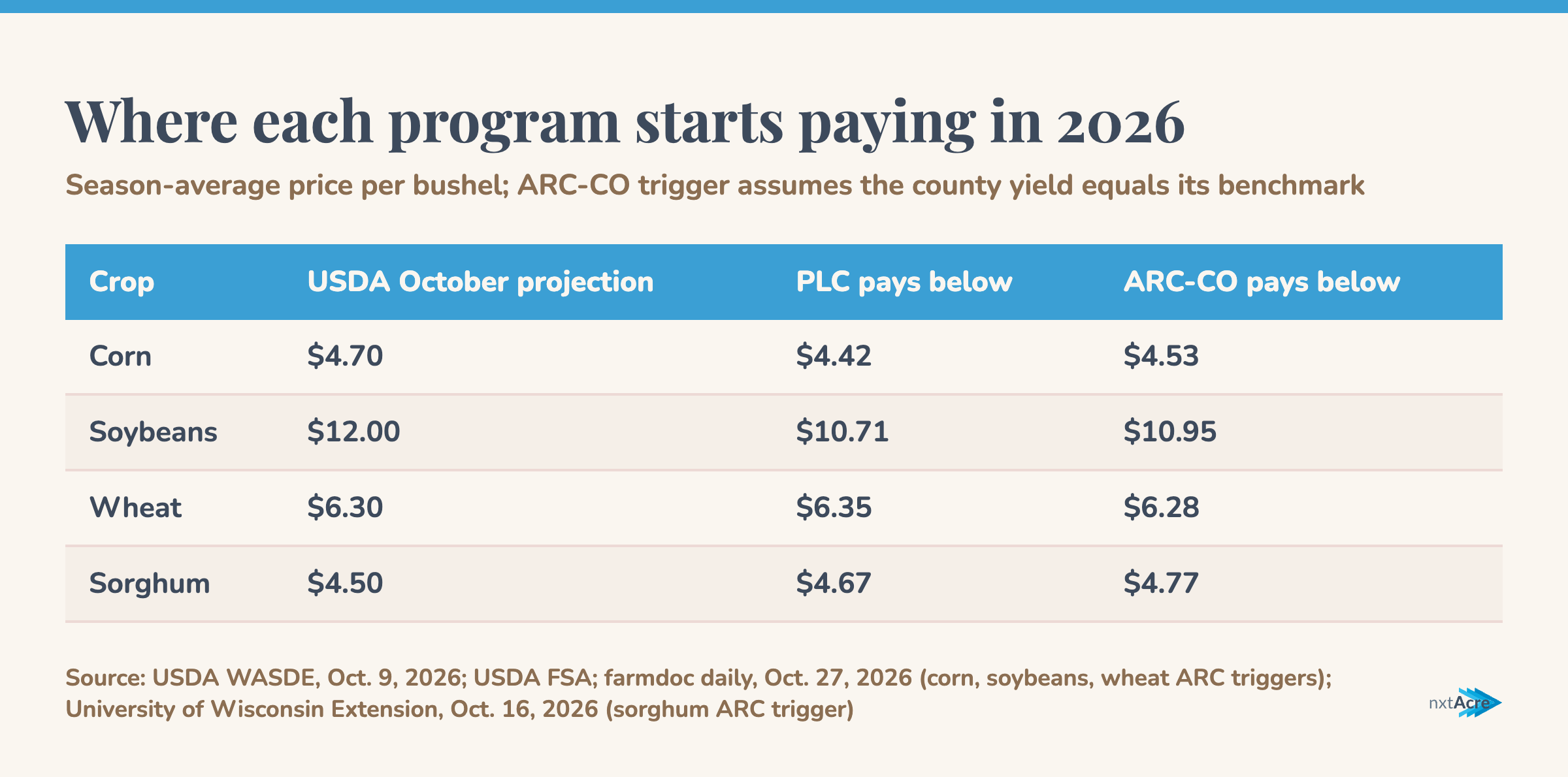
At October's $4.70, it takes a short county crop. Will Maples at Mississippi State figures ARC-CO pays on corn once the county yield falls 3.7% below its benchmark. PLC isn't expected to pay at all at that price.
Farmdoc ran one county through its online ARC/PLC Calculator: non-irrigated corn in Champaign County, Ill., where the county benchmark yield is 233 bushels. Averaged across a range of simulated price and yield outcomes, expected payments came to $44.98 per base acre for ARC-CO, with a 54% chance of a payment, and $15.80 for PLC, with a 29% chance.
Your county won't be Champaign, so run your own. But farmdoc's authors expect ARC-CO to trigger larger corn payments than PLC in most counties this year.
Should I pick ARC-CO or PLC for soybeans?
ARC-CO, according to both farmdoc daily and University of Wisconsin Extension. At $12.00, the season-average price would have to fall $1.29 before PLC paid anything. ARC-CO's trigger at a normal county yield is $10.95, and at October's price Mississippi State figures it pays after an 8.7% county yield shortfall.
If you already sold most of your 2026 beans, your price doesn't change any of this. PLC runs on base acres, your PLC yield and the national season-average price; ARC-CO swaps in county yields. Neither looks at what you got at the elevator, and neither depends on what you planted (FSA).
When does PLC make more sense than ARC-CO?
When the projected price is already under the reference price. Wheat is the close call. October's $6.30 is a nickel below the $6.35 reference price, and farmdoc says PLC "will have the larger expected payment for most farms," though farms in counties with poor wheat yields may do better with ARC-CO. Wisconsin recommends PLC for wheat. Mississippi State's Maples calls it close, since nearly any shortfall in the county yield would trigger ARC-CO.
Long-grain rice and peanuts lean harder toward PLC. Mississippi State used $14.00 per hundredweight for long-grain rice against a $16.90 reference price, and $480 a ton for peanuts (FSA's September projection) against $630. Its comparison found PLC pays more for rice unless a farm's PLC yield is about 40% of the county benchmark yield or less, and more for peanuts unless the PLC yield is about half the county benchmark or less.
Sorghum is the odd one. It projects under its reference price, yet Maples found ARC-CO "pays more for grain sorghum on nearly every farm," and Wisconsin recommends ARC-CO too. Wisconsin's ARC trigger price for sorghum is $4.77, above the $4.67 reference price. Seed cotton also projects under its reference price, with an ARC-CO trigger at a 5.7% county yield shortfall, per Mississippi State.
What we'd do before Dec. 11
- Get your base acres and PLC yields by crop from the county office, and check your new base allocation notice if you own land. Landowners with a Login.gov account can pull it up online at FSA's ARC/PLC page.
- Run your own county and your own PLC yield. Farmdoc's online ARC/PLC Calculator, Wisconsin's What-If Tool and Mississippi State's 2026 ARC-CO vs. PLC Payment Comparison all do this. Mississippi State's tool starts with the county average PLC yield, so type in yours from FSA.
- Remember elections are crop by crop. ARC-CO on corn and PLC on wheat on the same farm is fine.
- If you're on the fence, look again after the Nov. 10 and Dec. 10 WASDE reports, then sign. We wouldn't leave it to the last day.
And know your breakeven. A program payment that shows up in October 2027 is a backstop, not a plan. nxtAcre's profitability report shows income and expenses per field and per crop, so you can see what an acre of corn actually cost you this year before you lean on a payment to cover it.
Questions and answers
What happens if I miss the ARC/PLC deadline?
Your farm keeps its 2025 election on record, but it can't get a 2026 ARC or PLC payment. The 2026 deadline is Dec. 11, 2026. The 2027 sign-up opened Nov. 2 and runs through March 15, 2027.
Can I choose ARC-CO for corn and PLC for wheat?
Yes. ARC-CO and PLC both work crop by crop, so you can split them across crops on the same farm. ARC-IC is the exception: it covers the whole farm.
When are 2026 ARC and PLC payments made?
Not before October 2027. FSA pays after the crop's marketing year ends, and not before Oct. 1 of the year after the program year. The 2025 payment run was around Oct. 8, 2026.
Will FSA pay the higher of ARC or PLC again for 2026?
No. FSA's fact sheet says the higher-of payment was for 2025 only. For 2026 you get only the program you elect.