Building a 2027 corn budget when fertilizer might get cheaper
Published · 7 min read
What is fertilizer expected to cost in 2027?
Less than in 2026, and about what it cost in 2025. That's the World Bank's call in the Commodity Markets Outlook it released Oct. 28. Its forecast tables have the fertilizer price index up 14.3% in 2026 and down 12.4% in 2027.
Each product follows the same shape. Urea is forecast up 20.6% in 2026 and down 15.9% in 2027. DAP goes up 7.3%, then down 18.1%. Potash (potassium chloride) goes up 10.1%, then down 9.4%.
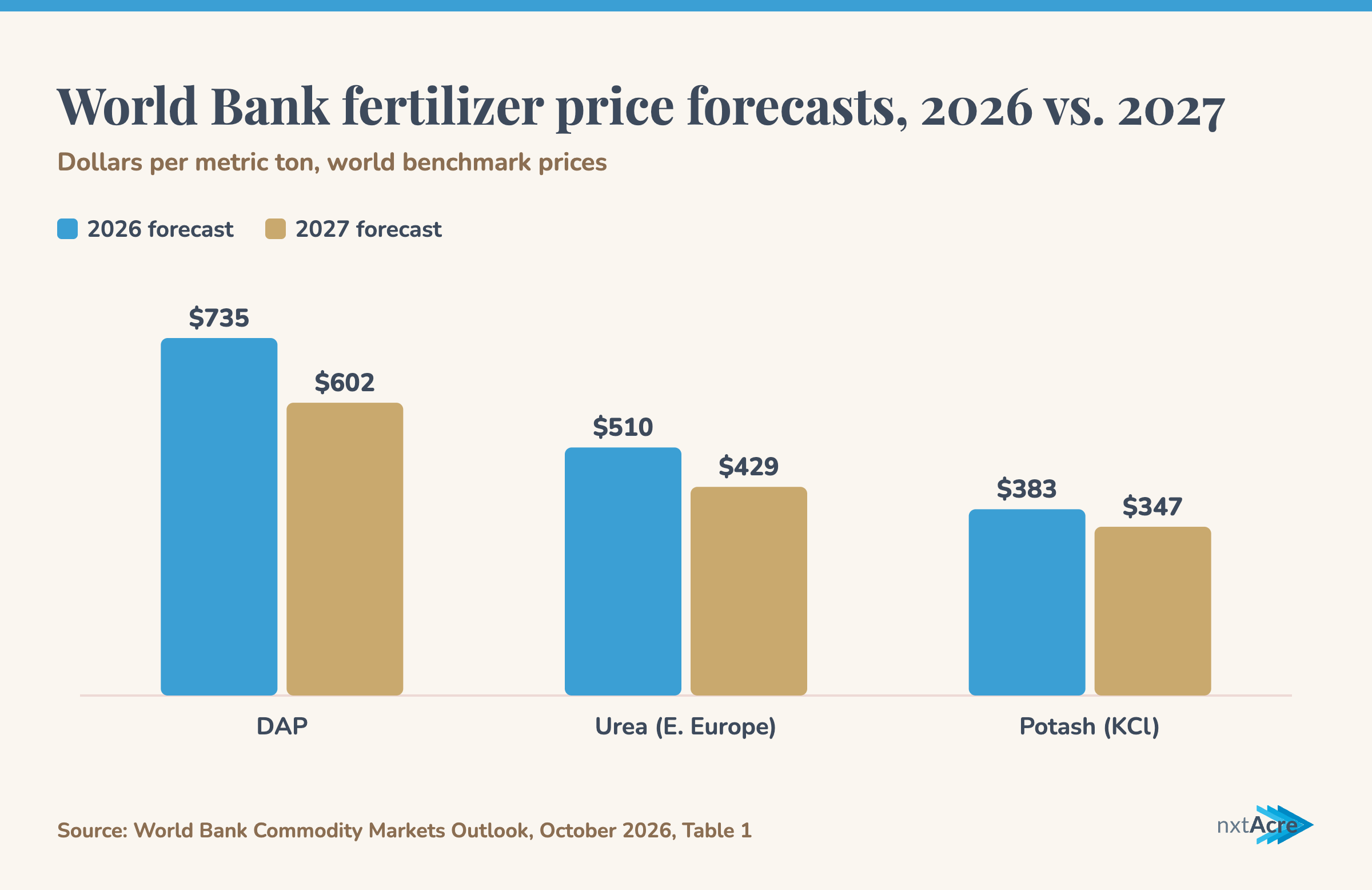
Two caveats before you pencil any of that in. These are world benchmark prices (the urea series is Eastern European urea), not your co-op's price sheet. And the World Bank's own release warns that energy prices could rise further if the conflict in the Middle East escalates. The American Farm Bureau, reading USDA's preliminary 2027 cost projections, ties the expected drop in fuel and fertilizer prices to traffic through the Strait of Hormuz getting back to normal.
Retail prices are still going the other way
At the dealer, fall 2026 costs more than fall 2025 did. DTN's retail survey for Oct. 19 to 23 had anhydrous at $987 a ton, 17% above a year earlier. Urea was $674 (up 13%), DAP $939 (up 1%) and potash $506 (up 4%). DTN said all eight fertilizers it tracks were priced above a year ago.
In Illinois, farmdoc daily reported anhydrous at $915.50 a ton on Aug. 7, 16% above the same time in 2025, and diesel at $4.65 a gallon, 54% above 2025. USDA's Sept. 3 farm income forecast puts 2026 production expenses at $492.8 billion, up 4.5%, with fertilizer up 15.3% and fuel up 28.8%.
So at the end of October the world forecast and the local price sheet point in opposite directions. Nobody knows yet how much of a 2027 drop will reach retail, or when.
The rest of the budget isn't expected to get cheaper. In a June 18 analysis of USDA's preliminary numbers, AFBF put 2027 corn at a record $952 an acre in total costs, with seed, chemicals, repairs, labor, machinery and cash rent all projected higher. Fuel and fertilizer prices were projected to drop, though AFBF said fertilizer would stay elevated, and it noted USDA would revise the projections in November. Terrain's Marc Rosenbohm told RFD-TV on July 9 that corn costs could fall about $7 an acre in 2027 and soybeans about $3, with higher repair and custom work bills eating part of the savings. That assumed energy flows through the Strait of Hormuz normalize and peace holds between the U.S. and Iran.
Start with a per-acre budget you can argue with
Use a published budget as the skeleton and replace every line you know better. Here's farmdoc's 2027 budget, released in August, for corn after soybeans on high-productivity central Illinois farmland, as published. It assumes a trend yield of 245 bushels and $5.00 corn, a price farmdoc based on 2027 harvest futures adjusted for typical Illinois basis.
| Per acre | farmdoc 2027 |
|---|---|
| Yield | 245 bu |
| Price | $5.00 |
| Crop revenue | $1,225 |
| ARC/PLC | $17 |
| Gross revenue | $1,242 |
| Fertilizers | $263 |
| Pesticides | $119 |
| Seed | $134 |
| Drying | $14 |
| Storage | $14 |
| Crop insurance | $35 |
| Total direct costs | $579 |
| Total power costs (machine hire, utilities, repair, fuel, vehicle, depreciation) | $186 |
| Total overhead costs (hired labor, buildings, insurance, misc., interest) | $120 |
| Total non-land costs | $885 |
| Land costs (cash rent) | $321 |
| Farmer return | $36 |
| Breakeven price, non-land costs | $3.61 |
| Breakeven price, non-land and land costs | $4.92 |
The $4.92 breakeven is the full cost per acre ($885 of non-land costs plus $321 of cash rent) divided by 245 bushels. Cover only the non-land costs and it's $3.61. farmdoc's summary calls its 2027 corn returns of $28 to $36 an acre in northern and central Illinois "slightly above break-even," so there isn't much room.
Fertilizer is the largest line after rent, about double the $134 for seed. Your farm isn't central Illinois, though. Put in your own rent, your seed quote and your actual repair bills. The structure is what's worth borrowing.
What moves a corn budget more, fertilizer or price?
On farmdoc's reading, price. Its Sept. 1 budget article says per-acre returns are "highly sensitive to prices given the relatively high productivity in Illinois," and that a 50-cent move in corn, less than harvest futures had moved in the month before, "results in a more than $100 shift in returns."
The same article shows how fast that side can swing. Most of the rise in corn and soybean prices came in the month before it ran. Before that, December 2026 corn futures had implied about $4.50 cash corn through the spring, and less in June and July. farmdoc's advice was to give serious thought to marketing that locks in prices above cost of production for at least part of the 2026 and 2027 crops, especially on operations with a lot of rented ground, higher debt or thin liquidity.
Keep in mind that farmdoc's own budget still has fertilizer going up for 2027, not down. The article lists fertilizers and crop insurance as the direct costs with the larger projected increases and points to higher fertilizer and fuel prices from the Iran war. A cheaper year is the World Bank's forecast for world prices, not something already in the Illinois numbers.
Then there's the crop mix. farmdoc projects soybeans returning $40 to $50 an acre more than corn in northern and central Illinois for 2027 ($86 against $36 on high-productivity central Illinois ground). Its August fertilizer piece lists planting more soybeans relative to corn as one way to cut the fertilizer bill.
Should I book 2027 fertilizer now or wait?
farmdoc's answer is some of each. In its August piece it wrote that "a diversified portfolio approach where a portion of nutrient needs for 2027 are priced this fall, despite high price levels, seems warranted."
The same piece lists other options. Shift more of the 2027 crop's nutrients from fall to spring. Revisit nitrogen rates against the maximum return to nitrogen (MRTN) guidelines. Soil test before deciding how much phosphorus and potassium to replace. With DAP expensive, farmdoc said some farmers may draw on phosphorus already in the soil and replace more of it in later years. That's a call to make with your agronomist and your soil tests in hand.
If you book in pieces, spring nitrogen, phosphate and potash are the parts with the most time left to price. DAP is also where the World Bank forecasts the biggest drop, 18.1%, though again that's a world price, not a quote.
Write each booking down with tons, price and date so you know your average cost per ton when it goes on. In nxtAcre you can enter each one as a purchase order against the fertilizer item in your inventory.
Keep actual cost per field so next year is not a guess
farmdoc builds its budgets largely from Illinois Farm Business Farm Management records, the publication says. You can build yours from your own. That means charging fertilizer, seed and chemical to the field they went on, along with custom application, drying and trucking, and recording yields by field instead of one bin total. After a few seasons you'll see which farms carry the operation and which ones barely cover rent.
nxtAcre's profitability report shows income and expenses by field and crop, so cost per acre comes from your books instead of memory.
Here's what we'd do before the next round of numbers:
- Rebuild farmdoc's per-acre budget with your own rent, seed quote and repair history.
- Run it at more than one corn price, since that's where farmdoc says returns swing most.
- Get written quotes for spring nitrogen and for P and K, and pull soil tests before setting P and K rates.
- Book part of what you need, leave part open, and record each booking.
- Check that 2026 costs are coded to fields before you close the books.
USDA's next WASDE reports are scheduled for Nov. 10 and Dec. 10. Revisit the budget when the price side moves.
Questions and answers
Will fertilizer really be cheaper in 2027?
The World Bank's Oct. 28 forecast has its fertilizer index falling 12.4% in 2027, back to about 2025 levels. Its release warns that energy prices could rise further if the Middle East conflict escalates. U.S. retail prices were still above year-earlier levels in DTN's Oct. 19 to 23 survey.
How do I calculate breakeven price per bushel?
Add up all costs per acre, including cash rent or a land charge, and divide by expected yield. In farmdoc's 2027 central Illinois budget for corn after soybeans, $885 of non-land costs plus $321 of rent over 245 bushels comes to $4.92.
Should I budget corn or soybeans for 2027?
farmdoc's first 2027 Illinois budgets show soybeans returning $40 to $50 an acre more than corn in northern and central Illinois. Your rotation, ground and markets matter more than a regional average, so run both budgets with your own numbers.
How much fertilizer is in farmdoc's 2027 corn budget?
farmdoc budgets $263 an acre for corn after soybeans on high-productivity central Illinois farmland and $273 for corn after corn. Northern Illinois corn after soybeans is budgeted at $249.